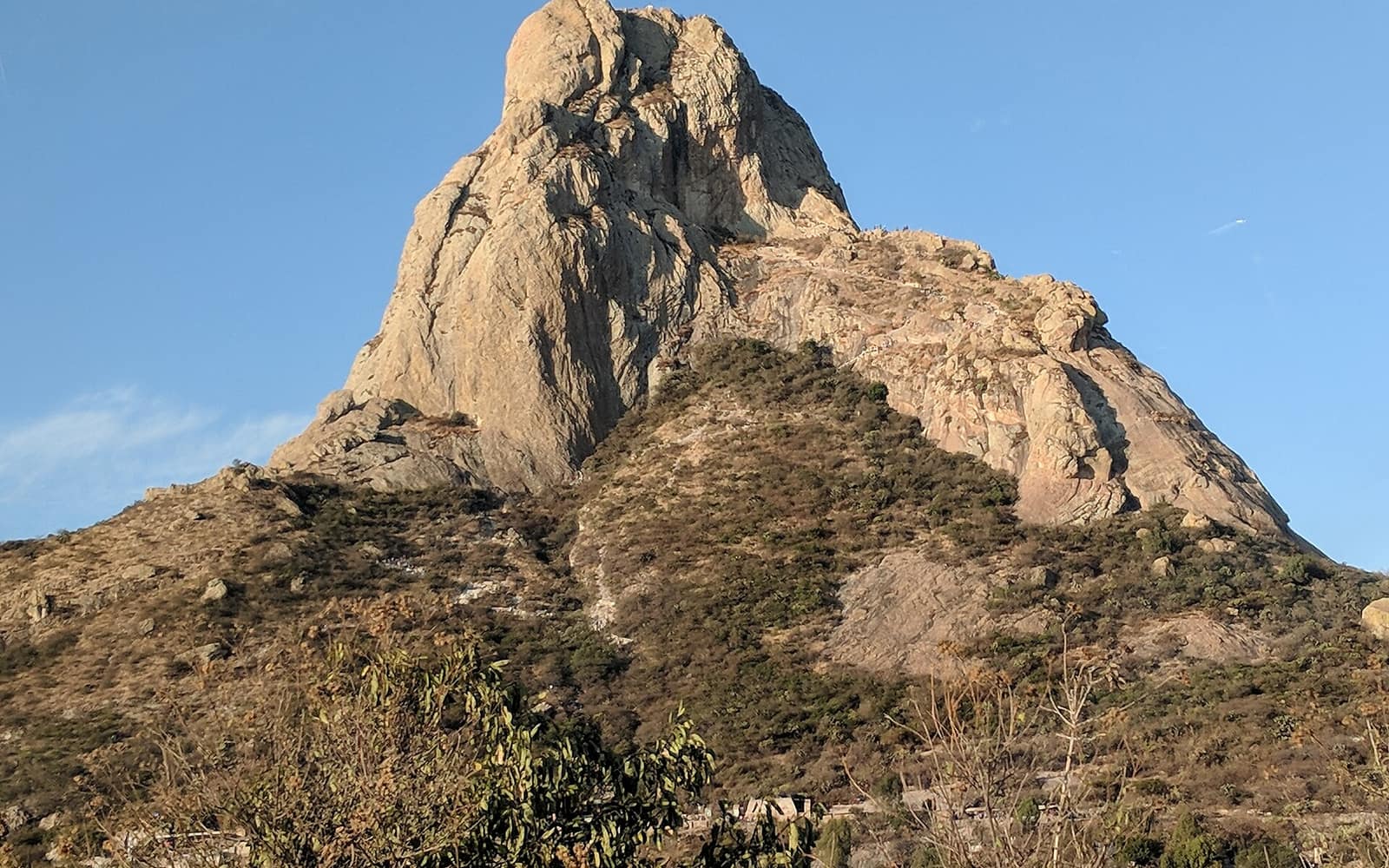
Energy · Querétaro · Otomí-Chichimeca · Core of an ancient volcano; a living sacred landscape today
Peña de Bernal
A vast volcanic monolith rising over a small Querétaro town, sacred to the Otomí-Chichimeca and widely known today as an energy site.
UNESCO Intangible Cultural Heritage (2009); a state Natural Monument; the foot-of-the-rock town of Bernal is a Pueblo Mágico.
It stands over the desert like a frozen wave of stone, one of the tallest rock monoliths in the world. To geologists it is the throat of a dead volcano. To the Otomí-Chichimeca it is the guardian of a sacred land, and to a steady stream of modern visitors it is a place to come and be recharged.
What you are looking at
Peña de Bernal is the hardened core of a volcano that has long since worn away. What remains is a single dome of dense rock rising in a near-vertical wall above the town, roughly 350 metres from base to summit and higher still if you measure from the valley floor. Recent geologic work reads it as an endogenous volcanic dome, magma that pushed up and cooled underground before erosion exposed it.
Sources disagree on exactly how it ranks. Some call it the third-tallest monolith on Earth, after the Rock of Gibraltar and Rio de Janeiro's Sugarloaf, while others simply place it among the tallest anywhere. Either way it is visible for many kilometres across the flat semi-desert, which is part of why it has drawn people for so long.
Guardian of a sacred territory
For the Otomí-Chichimeca people of Tolimán, the Peña is a living presence rather than a landmark. It forms one point of a sacred triangle with the nearby Zamorano and Frontón hills, and the semi-desert around it is mapped by oratory chapels, pilgrimage routes, and places of memory tied to their ancestors.
In 2009 UNESCO inscribed these practices on its Representative List of the Intangible Cultural Heritage of Humanity, under the title 'Places of memory and living traditions of the Otomí-Chichimecas people of Tolimán: the Peña de Bernal, guardian of a sacred territory.' The listing protects the living tradition, the pilgrimages and rituals and communal memory, not the rock as a tourist object.
A calendar built around water
Water is scarce in this semi-desert, and much of Otomí-Chichimeca ceremonial life turns on it. Communities make annual pilgrimages carrying revered crosses to pray for rain and protection, and the year is threaded with festivities that honour ancestors and renew a shared sense of belonging.
A striking part of these rites is the chimal, a tall temporary structure of reed and leaves raised as an offering and read as a symbol of endurance and vitality. Many observances happen quietly, in family chapels dedicated to the ancestors, well away from the paths that tourists walk.
The energy reputation
Separate from the indigenous tradition, the Peña has gained a contemporary reputation as an energy site. Many visitors and residents describe standing near it as calming or restorative, and some attribute this to the minerals in the rock. These are beliefs and personal accounts, reported here as reputation rather than established fact.
The reputation is most visible at the spring equinox, around 19 to 21 March, when thousands of people, many dressed in white, climb the lower slopes hoping to absorb the rock's energy. The gathering is festive and crowded, a modern ritual layered over a much older sacred landscape.
Standing there today
The town at the foot of the rock, San Sebastián Bernal, was founded in 1642 and named Querétaro's first Pueblo Mágico in 2005. Its cobbled lanes, food stalls, and craft shops make it an easy day trip from the city of Querétaro or from San Miguel de Allende.
A footpath climbs the lower third of the monolith to a small chapel and a run of viewpoints. It is steep and rocky but needs no ropes, and the sheer tower above is the preserve of technical climbers. Wear real shoes, carry water, and start early, both for the heat and for the view before the crowds arrive.
Did you know
- San Sebastián Bernal became the first Pueblo Mágico in the state of Querétaro in 2005.
- The monolith anchors a sacred triangle with the Zamorano and Frontón hills, all mapped in Otomí-Chichimeca cosmology.
- Some sources rank it the third-tallest monolith on Earth, behind the Rock of Gibraltar and Rio de Janeiro's Sugarloaf.
- You can hike to a chapel partway up, but the sheer upper wall is a well-known technical rock-climbing challenge.
- At the spring equinox, thousands dress in white and climb the lower slopes hoping to be charged with the rock's energy.
- Geologists describe the Peña as the exposed core of a volcano, magma that cooled underground before erosion laid it bare.
Through time
- c. 8.7 million years ago Magma cools underground, forming the volcanic dome later exposed as the Peña
- Pre-Hispanic era Otomí-Chichimeca peoples settle the semi-desert and hold the rock sacred
- 1642 Spanish settlers found the town of San Sebastián Bernal at the foot of the rock
- 2005 Bernal is named the first Pueblo Mágico in Querétaro
- 2009 UNESCO inscribes the Otomí-Chichimeca living traditions as Intangible Cultural Heritage
- Today Thousands gather each spring equinox, drawn by the rock's energy reputation
Before you go
Bernal sits about an hour by road from the city of Querétaro. Drive or take a regional bus to the town, then reach the monolith on foot from the centre.
October to March brings cooler, drier weather. The spring equinox around 21 March is the busiest and most atmospheric, but expect large crowds.
Half a day covers the trail and a wander through town. Allow a relaxed full day if you climb slowly and eat in the plaza.
The hillside chapel and any indigenous ceremony deserve quiet respect. Do not disturb rituals or leave litter, and stay on the marked path to protect the site.
Sources: UNESCO Intangible Cultural Heritage: Otomí-Chichimecas of Tolimán · Wikipedia: Peña de Bernal · Geosphere: Geologic setting of the Peña de Bernal Natural Monument · INAH: Lugares de memoria de los otomí-chichimecas de Tolimán · Querétaro Travel: Peña de Bernal
Nearby & related
A cliff-ringed Pueblo Mágico with a mountaintop pyramid and a long reputation as an energy centre.
Energy · Morelos Cristo Rey (Cerro del Cubilete)A 20-metre bronze Christ the King crowns the Cerro del Cubilete, a Guanajuato hill long claimed as the geographic center of Mexico and rebuilt as a national pilgrimage site after the Cristero War.
Sanctuaries · Guanajuato CatemacoA lakeside town in the Veracruz rainforest that Mexico knows as its capital of folk magic and healers.
Energy · VeracruzHold ceremony in Mexico?
Each vertical opens with a curation round: verified, or not listed. Tell us who you are, what you hold, and where we can check you.
For practitioners →