Nature · State of México · Matlatzinca and Nahua (Mexica) peoples · Late Postclassic offerings, c. 1200 to 1521 CE
Nevado de Toluca
A dormant volcano in the State of México whose summit crater holds two high lakes where people left offerings for centuries.
Flora and Fauna Protection Area (recategorized from national park in 2013)
Above the Toluca valley a dormant volcano rises to 4,680 metres, and its wide crater holds two still lakes, the Lake of the Sun and the Lake of the Moon. For centuries people climbed to this cold summit to lower offerings into the water. Divers are still finding what they left.
What you are looking at
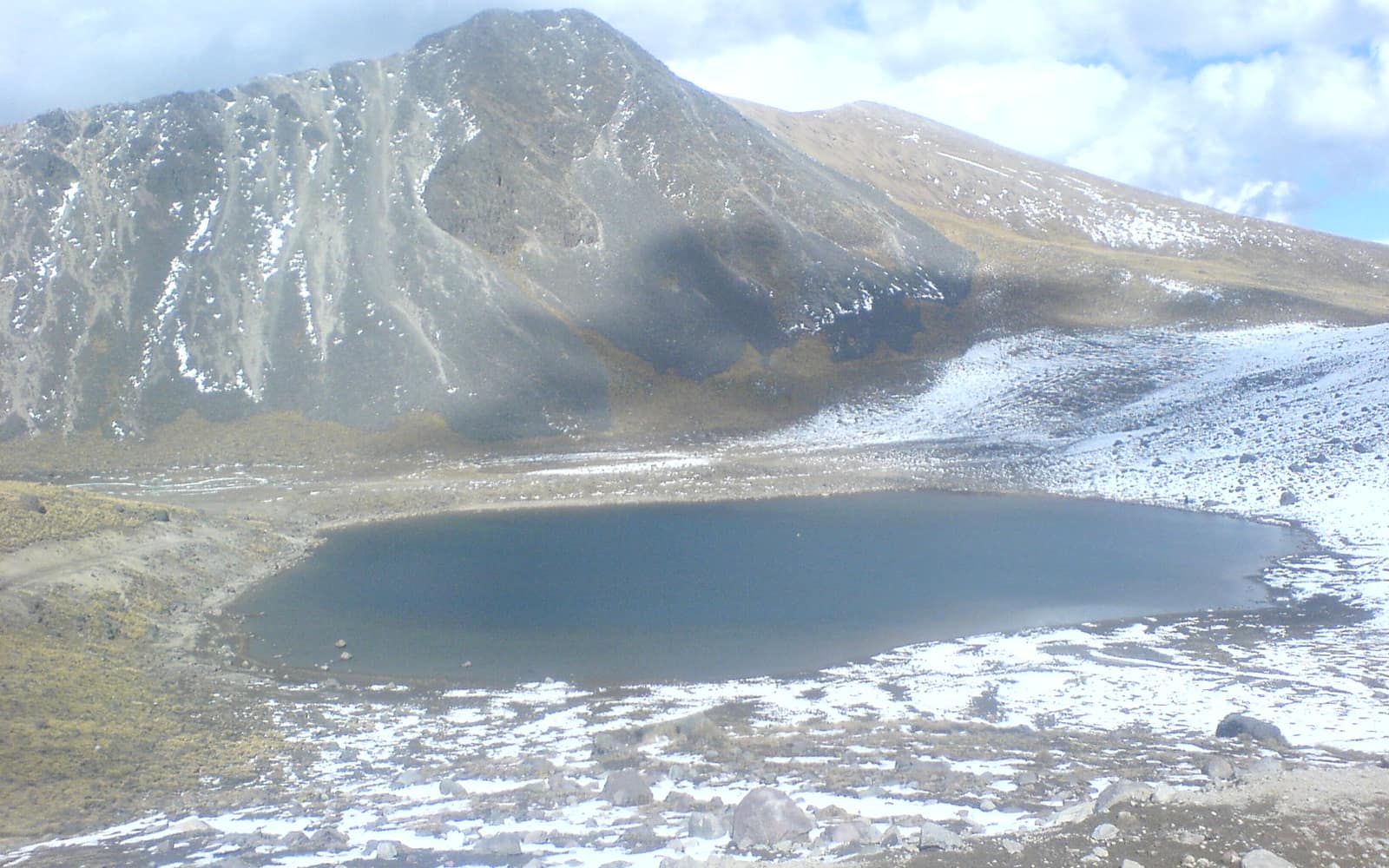
Nevado de Toluca is a stratovolcano about 80 kilometres west of Mexico City, standing over the Toluca valley. Its highest point, the Pico del Fraile at 4,680 metres, sits on the southwest rim of a summit caldera roughly 1.5 kilometres across that is open to the east. The volcano is dormant, with its last major eruption dated to around 10,500 years ago.
On the floor of the crater lie two lakes at about 4,200 metres. The larger is Lago del Sol, the Lake of the Sun, and the smaller but deeper is Lago de la Luna, the Lake of the Moon. Their clarity, cold, and thin air are part of what made the summit feel set apart.
The offerings in the lakes
The lakes are one of the richest high-altitude offering sites known in central Mexico. Underwater surveys have recovered copal resin, obsidian blades, ceramics, carved stone, rubber, and maguey spines, the last used for ritual bloodletting. In 2007 divers documented dozens of pre-Hispanic ritual objects in the Lake of the Moon, kept in place as the first in situ underwater archaeological archive in the country.
Radiocarbon dating of the wood, copal, and maguey has built a chronology of this ritual activity. The busiest period was during Matlatzinca times in the Late Postclassic, more so than in the later Aztec era, a pattern researchers link to a heightened need for rain and good growing conditions. Reports of wooden scepters shaped like lightning bolts echo 16th-century Spanish accounts of offerings to the rain god.
Why it is sacred
In the cosmology of the peoples who lived around it, a high mountain that gathered cloud, snow, and standing water was a source of rain and fertility. By tradition Nevado de Toluca was associated with the rain god Tlaloc, and the summit lakes were places to petition for water and give thanks.
The offerings were not casual. Reaching the crater meant a hard climb into thin, freezing air, and what people carried up, copal to burn, blades and spines for sacrifice, carved wood, was chosen with care. The account of the chronicler Bernardino de Sahagún records the lakes as a place of ceremony and sacrifice.
The name and the record
The mountain's common name, Nevado de Toluca, means the snow-capped peak of Toluca. Its Nahuatl name Xinantécatl is widely used, though scholars note the older form Chicnauhtecatl, understood as Lord of Nine, probably a reference to its deep lakes.
Written records of the site begin with the Spanish chroniclers of the 16th century and continue through modern archaeology, with formal underwater studies from the late 20th century onward. Together the offerings and the texts make the volcano one of the better-documented sacred mountains of the region.
Standing there today
The volcano was declared a national park in 1936 and recategorized in 2013 as a Flora and Fauna Protection Area covering about 53,590 hectares, a change meant to balance conservation with local use. A road climbs high toward the crater, and a rough track and a walk lead to the lakes.
At over 4,000 metres the air is thin and the cold is real, and the lakes remain both a protected natural feature and a living heritage site. Visitors come for the crater, the two lakes, and the long views, and are asked to keep out of the water and leave the offerings and the ground undisturbed.
Did you know
- The older name Chicnauhtecatl is read as Lord of Nine, probably a reference to the mountain's deep lakes.
- The 2007 finds in the Lake of the Moon form the first in situ underwater archaeological archive in Mexico, held in a container that lets lake water flow over the objects.
- Radiocarbon dating shows the busiest era of offerings was Matlatzinca times, not the later Aztec period.
- Maguey spines recovered from the lakes were used for ritual self-sacrifice, drawing blood as an offering.
- Wooden scepters shaped like lightning bolts match 16th-century Spanish descriptions of offerings to the rain god Tlaloc.
- Nevado de Toluca is the fourth highest peak in Mexico, after Pico de Orizaba, Popocatépetl, and Iztaccíhuatl.
- The Lake of the Moon is smaller than the Lake of the Sun but noticeably deeper.
Through time
- c. 10,500 BP The volcano's last major eruption; it enters a long dormancy.
- Late Postclassic Peak of ritual offerings in the lakes, mostly by Matlatzinca people.
- 16th century Spanish chroniclers, including Sahagún, record ceremonies at the summit lakes.
- 1936 Nevado de Toluca is declared a national park by decree.
- 2007 Divers document dozens of pre-Hispanic offerings in the Lake of the Moon.
- 2013 The park is recategorized as a Flora and Fauna Protection Area.
Before you go
Reach the park by road from Toluca or Mexico City, then a rough track and a high-altitude walk to the crater lakes at about 4,200 metres. Access is sometimes restricted, so confirm current park conditions before setting out.
The dry months, roughly November to March, give the clearest skies. The summit is cold all year and can hold snow.
Plan a half to full day, and allow time to acclimatise to the altitude before walking to the lakes.
The lakes are an active archaeological and sacred site: do not enter the water, dive for, touch, or remove anything, and carry out all your trash. Treat any offerings you see as belonging to the place.
Sources: Wikipedia: Nevado de Toluca · Wikipedia: Nevado de Toluca National Park · Radiocarbon (Cambridge Core): Underwater Archaeological Objects from the Nevado de Toluca · Mexico News Daily: Archaeological objects deposited in lake · Smithsonian Global Volcanism Program: Nevado de Toluca · DOF: Programa de Manejo, APFF Nevado de Toluca
Nearby & related
The vast city of pyramids the Aztecs later called “the place where the gods were created.”
Ancient · State of México Hierve el AguaPetrified “waterfalls” of mineral springs, a Zapotec bathing and ritual site for millennia.
Nature · Oaxaca Basílica de GuadalupeThe most visited Catholic shrine in the Americas, on a hill that was sacred long before it.
Sanctuaries · Mexico City Tepoztlán & El TepoztecoA cliff-ringed Pueblo Mágico with a mountaintop pyramid and a long reputation as an energy centre.
Energy · Morelos CholulaThe largest pyramid ever built by volume, now a grass-covered hill topped by a colonial church, with pilgrims still climbing to the summit.
Ancient · PueblaHold ceremony in Mexico?
Each vertical opens with a curation round: verified, or not listed. Tell us who you are, what you hold, and where we can check you.
For practitioners →