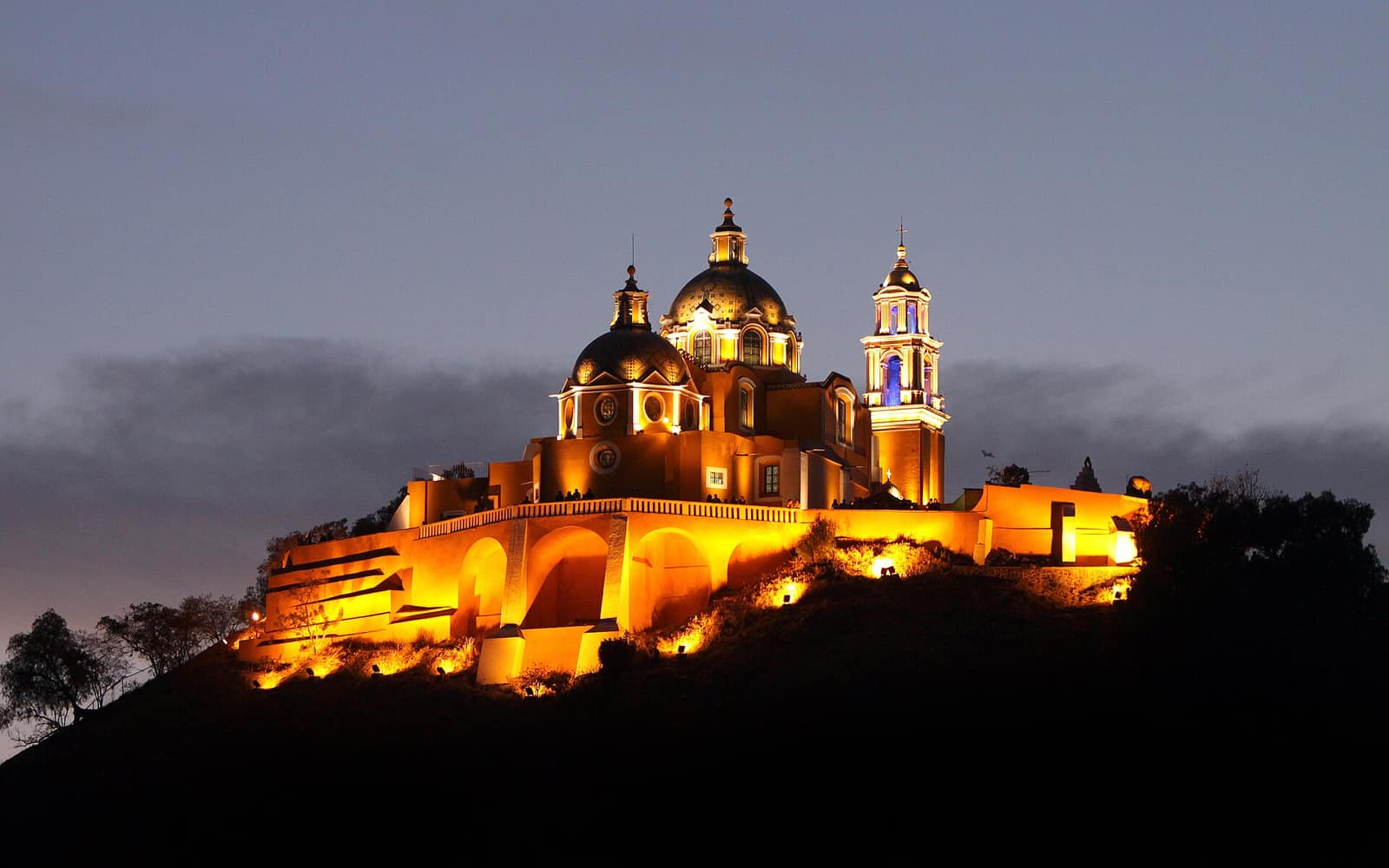
Ancient · Puebla · Successive Nahua peoples: Olmeca-Xicalanca and Tolteca-Chichimeca · Built c. 300 BCE to 900 CE; a place of worship ever since
Cholula
The largest pyramid ever built by volume, now a grass-covered hill topped by a colonial church, with pilgrims still climbing to the summit.
INAH-protected archaeological zone and active Catholic sanctuary
From the road it looks like a wooded hill with a yellow church on top. It is in fact the largest pyramid ever built, a mountain of sun-dried brick raised over a thousand years and left to green over. People have worshipped on this spot, in one form or another, for more than two thousand years.
The constructed mountain
The Nahua name for the pyramid is Tlachihualtepetl, the hand-made or constructed mountain, and the name is literal. Builders raised it in at least four main phases between roughly the third century BCE and the ninth century CE, each generation casing the older temple inside a larger one, like nesting shells. The finished mass runs to about 4.45 million cubic metres, more than one and a half times the volume of the Great Pyramid of Giza, though it stands lower and much broader.
It was made mostly of adobe, sun-dried mud brick, rather than cut stone. Once it was abandoned, the earth and vegetation that gathered over it turned the whole structure into what reads today as a natural hill.
City of Quetzalcoatl
By tradition the pyramid was dedicated to Quetzalcoatl, the feathered serpent. Cholula was one of the oldest and most important religious centers in Mesoamerica, occupied continuously from around 500 BCE and, for long stretches, a rival to Teotihuacan.
It drew pilgrims from far beyond the valley. Accounts hold that the two high priests of the Temple of Quetzalcoatl confirmed the legitimacy of rulers who came from other kingdoms, which gave the city unusual authority across the eastern Nahua world.
Conquest and massacre
Hernan Cortes reached Cholula in October 1519 on his march to the Aztec capital. Warned, by his own account, of an ambush, he and his Tlaxcalan allies turned on the city and killed thousands of largely unarmed people in the sacred precinct within a few hours. Spanish sources put the dead at around six thousand.
The massacre broke Cholula as an independent power, and it is still commemorated and argued over in the city today.
A church on the summit
Rather than tear the pyramid down, the Spanish built on top of it. The church of Nuestra Senora de los Remedios rose on the summit in the late sixteenth century, replacing the shrine that had stood there. Earthquakes have damaged and reshaped it over the centuries, and much of what stands now is a later rebuild.
Because worship shifted from the old temple to the church without a break, the site is often described as the oldest continuously used place of worship in the Americas. Every September, during the feast of the Virgin of Los Remedios, pilgrims climb to the summit and sing Las Mananitas to her at dawn.
Standing there today
Most of the pyramid is still inside the hill. Archaeologists tunneled about eight kilometres through its core from 1931 onward, and roughly eight hundred metres of those passages are open, narrow and lit, running past the buried stairways of earlier temples.
From the church terrace on a clear day you can see the Popocatepetl volcano to the west, often trailing steam. The climb is short, and the view takes in the town, its many church domes, and the plain the city once commanded.
Did you know
- Because the pyramid had greened over into a hill, the Spanish never realised the temple was there, and it survived beneath their church.
- Locals say Cholula has a church for every day of the year, though fewer than fifty were ever actually built.
- By volume it is the largest pyramid on Earth, larger than the Great Pyramid of Giza, even though Giza rises more than twice as high.
- Archaeologists dug about eight kilometres of tunnels through the pyramid, but only around eight hundred metres are open to walk.
- It is often called the oldest continuously occupied building in the Americas, because worship never stopped when the church replaced the shrine.
- At dawn on the September feast day, pilgrims sing Las Mananitas to the Virgin of Los Remedios at the church on the summit.
Through time
- c. 300 BCE The first platform of the great pyramid is raised
- c. 200 to 800 CE Pyramid enlarged in stages; Cholula becomes a major religious center
- c. 900 CE The great pyramid is abandoned and left to weather
- October 1519 Cortes and Tlaxcalan allies massacre thousands in the city
- c. 1594 Church of Nuestra Senora de los Remedios built on the summit
- 1931 Ignacio Marquina begins tunneling to explore the buried pyramid
- Today INAH archaeological zone and living September pilgrimage
Before you go
Cholula sits about 10 km west of the city of Puebla, roughly two hours by road from Mexico City. Local buses and taxis reach the archaeological zone and the base of the pyramid.
Weekday mornings are quietest. The Feria de Cholula fills the site in early September, around the feast of the Virgin of Los Remedios on 8 September.
Two to three hours covers the tunnels, the site museum, and the climb to the summit church.
The church on top is an active place of worship, so keep quiet during Mass and dress modestly. Stay on the marked paths through the tunnels and over the mound, and do not climb on the exposed ruins.
Sources: Wikipedia: Great Pyramid of Cholula · Wikipedia: Cholula (Mesoamerican site) · INAH: Zona Arqueologica de Cholula · Guinness World Records: Largest pyramid · Wikipedia: Iglesia de Nuestra Senora de los Remedios, Cholula
Nearby & related
The vast city of pyramids the Aztecs later called “the place where the gods were created.”
Ancient · State of México Chichén ItzáThe Maya city whose pyramid still catches the equinox serpent of light on its steps.
Ancient · Yucatán Monte AlbánA Zapotec capital levelled from a ridge-top, floating above the valley of Oaxaca.
Ancient · Oaxaca PalenqueThe rainforest Maya city of Pakal, where fine stone temples meet the jungle canopy.
Ancient · Chiapas Basílica de GuadalupeThe most visited Catholic shrine in the Americas, on a hill that was sacred long before it.
Sanctuaries · Mexico CityHold ceremony in Mexico?
Each vertical opens with a curation round: verified, or not listed. Tell us who you are, what you hold, and where we can check you.
For practitioners →