Nature · State of México · Nahua (Mexica and contemporary Nahua peoples) · Pre-Hispanic to present
Popocatépetl & Iztaccíhuatl
Two great volcanoes east of Mexico City, one smoking and alive, the other still as a sleeping woman, honoured by the Nahua as living beings.
Iztaccíhuatl-Popocatépetl National Park (1935); the surrounding 16th-century monasteries are a UNESCO World Heritage Site (1994)
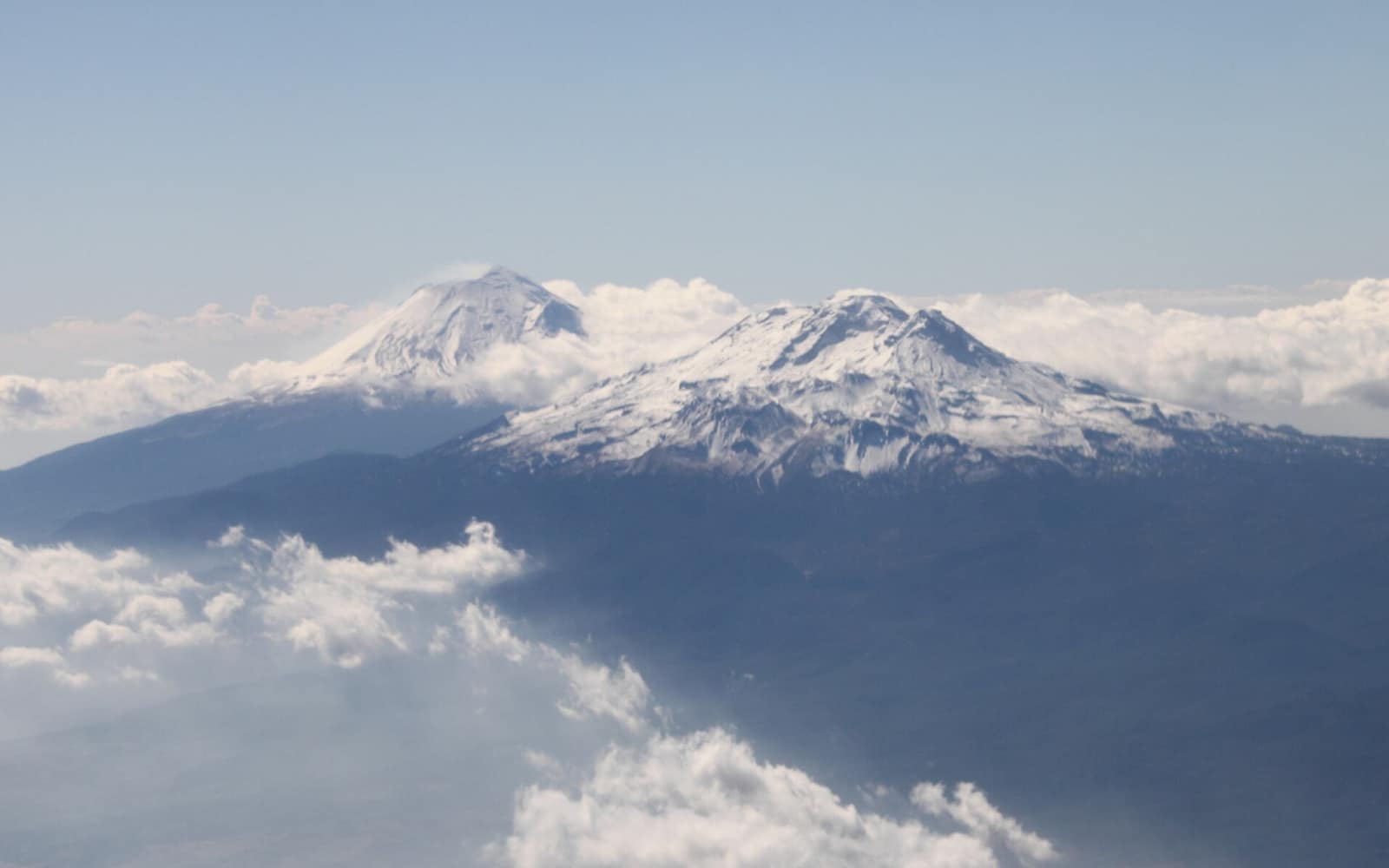
Two snow-capped giants close the eastern rim of the Valley of Mexico. One smokes; the other lies still, her ridgeline shaped like a woman asleep on her back. For the Nahua they are not scenery but persons, watched, fed and named, and one of them is still very much alive.
The legend
According to a story told long before the Spanish arrived, Popocatépetl was a warrior in love with Iztaccíhuatl, the daughter of a ruler. He was sent to war on the promise that he could marry her if he came back victorious. In his absence a rival spread word that he had died, and the princess died of grief.
When Popocatépetl came home and found her gone, the account holds, he carried her body up to the mountains and laid her down. He knelt beside her with a smoking torch to keep watch, and the two were turned to snow and rock. That is why, tradition says, one peak lies still in the shape of a sleeping woman and the other smokes over her without end.
What you are looking at
The two volcanoes are joined by a high saddle called Paso de Cortés, at about 3,600 m. From it the names make sense: Popocatépetl is a steep cone that vents gas and ash, while Iztaccíhuatl is a long ridge whose rises read as a head, chest, knees and feet.
Both stand inside Iztaccíhuatl-Popocatépetl National Park, created in 1935 and one of the oldest in Mexico. Popocatépetl reaches around 5,393 m and Iztaccíhuatl around 5,230 m, making them the second and third highest mountains in the country after Pico de Orizaba.
Why it is sacred
Nahua peoples have lived around these mountains for a very long time, and worship on the peaks is old: ruined shrines have been found as high as about 3,600 m. The volcanoes are treated as living, weather-making powers rather than as inert rock.
Popocatépetl is known affectionately as Don Goyo, short for Gregorio, and is celebrated on 12 March, the feast of Saint Gregory. Specialists called tiemperos or graniceros, said to be chosen by the volcano through dreams or a lightning strike, lead the rites. On the mountain birthday people carry flowers, food and drink high up the slope and leave them near the crater, asking for rain and calm.
The monasteries below
On the lower slopes and in the valleys around the volcanoes stand fourteen monasteries built in the 16th century by Franciscan, Dominican and Augustinian friars as they converted the region. Together they were listed by UNESCO as a World Heritage Site in 1994.
They are early and unusually complete, and they introduced a new kind of religious space for open-air worship by large indigenous congregations: wide walled atria and small corner posa chapels. Sites such as Tepoztlán, Tlayacapan and Tochimilco preserve them well.
Standing there today
You can drive up to Paso de Cortés, pay a small park fee at the CONANP visitor centre, and walk the viewpoints or the little museum. Iztaccíhuatl is climbed from the La Joya trailhead as a serious high-altitude ascent, best done with a guide and proper acclimatisation.
Popocatépetl is another matter. It is one of the most active volcanoes in North America, closed to climbers since it reawakened in 1994, and its crater is off limits. Emissions still dust nearby towns with ash and, in May 2023, briefly closed Mexico City's airports. Come to watch it and to respect the people for whom it is family, not to conquer it.
Did you know
- Popocatépetl reawakened in December 1994 after decades of quiet and has been intermittently active ever since.
- In May 2023 ashfall from the volcano forced both of Mexico City's airports to close for a time.
- Locals call the volcano Don Goyo, from Gregorio, and mark his birthday on 12 March, the feast of Saint Gregory the Great.
- Iztaccíhuatl's separate summits are read as the head, chest, knees and feet of a woman lying on her back.
- In 1519 soldiers of Hernán Cortés crossed the saddle now named Paso de Cortés, and one of them, Diego de Ordaz, climbed toward the crater for sulphur.
- Shrine ruins have been found near 3,600 m on the peaks, evidence that people climbed here to worship long before the Spanish arrived.
Through time
- Pre-Hispanic Nahua peoples honour the peaks and build shrines high on the slopes.
- 1519 Cortés's expedition crosses the saddle later called Paso de Cortés toward Tenochtitlan.
- 16th century Franciscan, Dominican and Augustinian friars build monasteries on the lower slopes.
- 1935 Iztaccíhuatl-Popocatépetl is declared a national park, among Mexico's first.
- 1994 UNESCO lists the monasteries; Popocatépetl reawakens in December and climbing is banned.
- 2023 Renewed ash emissions raise the alert level and briefly close Mexico City's airports.
Before you go
From Mexico City it is about 70 km southeast. Drive or take a tour through Amecameca to the Paso de Cortés visitor centre; the La Joya trailhead for Iztaccíhuatl lies further along the same road.
November to February brings the clearest, driest skies and the best chance of snow. Always check the volcanic alert level before setting out.
Half a day for the Paso de Cortés viewpoints and museum. A climb of Iztaccíhuatl is a demanding one to two day expedition.
This is a living sacred landscape and an active volcano at once. Keep to marked trails, respect the crater exclusion zone around Popocatépetl, leave offerings and shrines untouched, and follow CONANP and Civil Protection instructions.
Sources: UNESCO: Earliest 16th-Century Monasteries on the Slopes of Popocatepetl · Wikipedia: Popocatépetl · Wikipedia: Iztaccíhuatl · Wikipedia: Popocatépetl and Iztaccíhuatl (the legend) · Global Volcanism Program (Smithsonian): Popocatépetl
Nearby & related
The vast city of pyramids the Aztecs later called “the place where the gods were created.”
Ancient · State of México Hierve el AguaPetrified “waterfalls” of mineral springs, a Zapotec bathing and ritual site for millennia.
Nature · Oaxaca Basílica de GuadalupeThe most visited Catholic shrine in the Americas, on a hill that was sacred long before it.
Sanctuaries · Mexico City Tepoztlán & El TepoztecoA cliff-ringed Pueblo Mágico with a mountaintop pyramid and a long reputation as an energy centre.
Energy · Morelos CholulaThe largest pyramid ever built by volume, now a grass-covered hill topped by a colonial church, with pilgrims still climbing to the summit.
Ancient · PueblaHold ceremony in Mexico?
Each vertical opens with a curation round: verified, or not listed. Tell us who you are, what you hold, and where we can check you.
For practitioners →