Sanctuaries · State of México · Nahua cave cult of Oztoteotl, then Augustinian Catholic · Pre-Hispanic cave cult; Catholic sanctuary since the 1530s
Chalma
A canyon shrine to a Black Christ that grew over an older cave cult, and Mexico's second most important pilgrimage site after Guadalupe.
Active Roman Catholic sanctuary, one of Mexico's principal national pilgrimage sites
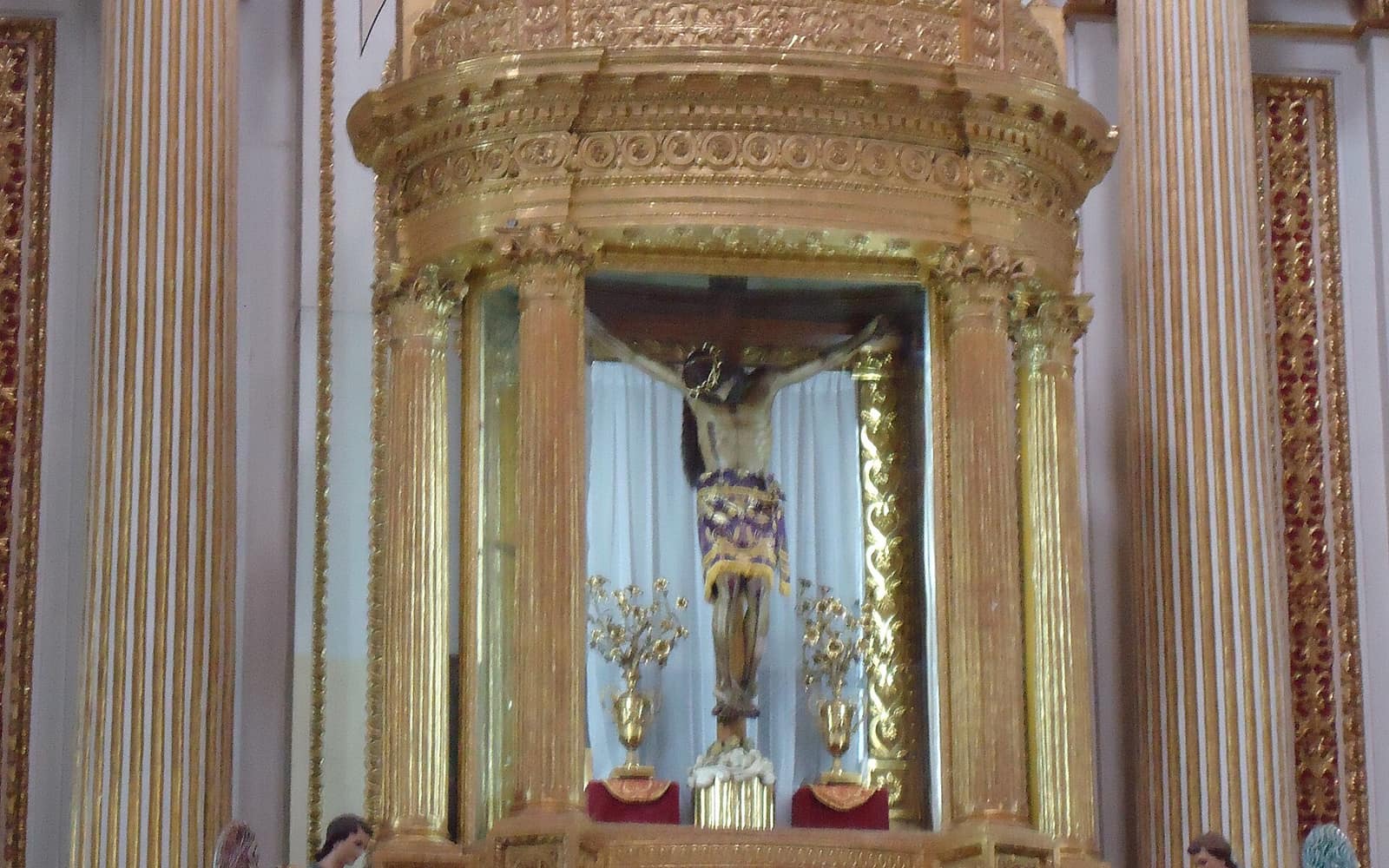
Deep in a canyon east of Malinalco, a Black Christ hangs in a church built where a cave god once stood. Pilgrims still walk for days to reach it, bathe at a spring beneath an ancient cypress, and dance at the door. The Catholic shrine kept the shape of the rite it replaced.
The cave god before the church
The Augustinian friars who reached this canyon in the 1530s found a cult already old. In one of the caves stood a dark, cylindrical idol the Nahua called Oztoteotl, the lord of the cave, a figure that tradition links to Tezcatlipoca, the smoking mirror and god of night and human fate. Pilgrims walked for days to reach it, carried flowers and incense, bathed in the river, and went into the cave to ask for healing.
This was not a quiet local shrine. The rite drew people from across the central highlands, and some accounts hold that it once included human sacrifice. When the friars set out to convert the region, they aimed straight at Chalma.
The Black Christ appears
According to tradition, the friars pressed the local people to abandon the idol, and around 1539 the cylindrical figure was found broken to pieces. In its place, the account holds, stood a life-sized Black Christ of the same dark stone. No one claimed to have carved it.
The image stayed in the cave for about 143 years. In 1683 the Augustinians moved it down to a church built on the canyon floor and founded a monastery to attend to the pilgrims. In 1783 the Spanish crown placed the sanctuary under royal protection, and its full name still calls it the Royal Monastery and Sanctuary of Our Lord and Saint Michael of the Caves of Chalma. The image described in the old accounts was later lost to an 18th-century fire, and the Christ venerated today is a recreation.
The tree, the spring, the dance
Before most pilgrims reach the church they stop at the ahuehuete, an immense old cypress whose Nahuatl name means old man of the water. A spring rises at its roots and feeds pools where pilgrims bathe, often fully clothed. First-time visitors circle the tree, take a crown of flowers, and wash before going on.
At the sanctuary itself, groups dance at the entrance in costumes brought from towns all over the country, an act pilgrims believe helps cleanse them. The bathing, the flower crowns, and the dance are close to what pre-Hispanic pilgrims performed here, carried into a Catholic frame. A Mexican saying still names a hopeless task as one you could not manage even by going to dance at Chalma.
Standing there today
Chalma is a small town in the municipality of Malinalco that lives almost entirely to serve its pilgrims. It lies about 11 kilometres east of Malinalco and roughly 95 kilometres from Mexico City, reached by a road that winds down into the canyon.
On ordinary days it is busy. On the first Friday of Lent, during Holy Week, at Pentecost, and around the 1 July feast, tens of thousands of people arrive at once, many on foot and some on their knees for the last stretch. Across a year the sanctuary counts on the order of two million visitors, which places it second only to the Basilica of Guadalupe.
Did you know
- The name of the sacred cypress, ahuehuete, means old man of the water in Nahuatl.
- First-time pilgrims are expected to circle the tree and bathe at the spring, and a local belief warns that skipping the rite could turn you to stone.
- Some pilgrims tie a baby's umbilical cord to the tree, or reach into a water-filled hollow, asking for fertility.
- The Christ venerated now is a recreation; the image described in the old accounts was destroyed in an 18th-century fire.
- A common Mexican expression frames a hopeless task as one that could not be done even by going to dance at Chalma.
- The idol the friars found was linked to Tezcatlipoca, the Aztec smoking mirror associated with night, caves, and human fate.
- The Black Christ stayed in its cave for about 143 years before it was moved to a purpose-built church in 1683.
Through time
- c. 1530s Augustinian friars reach the canyon and find the Oztoteotl cave cult
- c. 1539 By tradition, the idol is found shattered and a Black Christ appears in its place
- 1683 The image is moved to a new church and a monastery is founded for the pilgrims
- 1721 Major rebuilding of the sanctuary complex
- 1783 The Spanish crown places the sanctuary under royal protection
- Today Around two million visitors a year, Mexico's second pilgrimage site
Before you go
Chalma lies in a canyon about 11 kilometres east of Malinalco and roughly 95 kilometres southwest of Mexico City. Buses and organised pilgrim trips run from Mexico City, Toluca, and Cuernavaca, and the last stretch drops steeply into the town.
Weekdays outside the big feasts are the calmest. Expect vast crowds on the first Friday of Lent, in Holy Week, at Pentecost, and around the 1 July feast day.
Half a day covers the sanctuary, the ahuehuete tree, and the spring. Allow a full day if you join a pilgrimage or walk part of the route on foot.
This is a working shrine, not a sight. Watch the dancing and the bathing quietly, ask before photographing people at prayer, and keep the spring and the tree free of litter.
Sources: Wikipedia: Chalma, Malinalco · Martin Gray, Sacred Sites: Chalma · MexConnect: The magic of Chalma · Atlas Obscura: Ahuehuete de Chalma
Nearby & related
The vast city of pyramids the Aztecs later called “the place where the gods were created.”
Ancient · State of México WirikutaThe most sacred land of the Wixárika people, endpoint of an ancient pilgrimage across the desert.
Sanctuaries · San Luis Potosí Basílica de GuadalupeThe most visited Catholic shrine in the Americas, on a hill that was sacred long before it.
Sanctuaries · Mexico City Tepoztlán & El TepoztecoA cliff-ringed Pueblo Mágico with a mountaintop pyramid and a long reputation as an energy centre.
Energy · Morelos CholulaThe largest pyramid ever built by volume, now a grass-covered hill topped by a colonial church, with pilgrims still climbing to the summit.
Ancient · PueblaHold ceremony in Mexico?
Each vertical opens with a curation round: verified, or not listed. Tell us who you are, what you hold, and where we can check you.
For practitioners →