Ancient · Chiapas · Maya · c. 226 BCE – 799 CE
Palenque
The rainforest Maya city of Pakal, where fine stone temples meet the jungle canopy.
UNESCO World Heritage · INAH zone
Deep in the Chiapas rainforest, where mist rises off the ridges and howler monkeys roar in the canopy, the Maya built some of the finest stone temples in the Americas. This was Lakamha, the place they called big water, ruled at its height by K'inich Janaab' Pakal. His tomb waited undisturbed inside a pyramid for more than twelve centuries.
The story
Palenque rose from a modest forest settlement into one of the most refined cities of the Classic Maya world. Its ancient name was Lakamha, big water, for the streams and springs that thread the site. The ruling dynasty traces back to 431 CE, but the city's golden age belongs to one long life. In 615 a boy of about twelve took the throne as K'inich Janaab' Pakal, with his mother, Lady Sak K'uk', ruling as regent until he came of age.
Pakal reigned for roughly sixty-eight years, the longest of any monarch recorded in the Americas. He rebuilt Palenque after a bruising defeat by the rival superpower of Calakmul, commissioning palaces and temples covered in crisp stucco and carved stone. His son K'inich Kan Bahlam II carried the work forward. By about 900 CE the city was abandoned, and the forest closed over it for a thousand years.
The tomb beneath the temple
In 1952 the Mexican archaeologist Alberto Ruz Lhuillier noticed that a slab in the floor of the Temple of the Inscriptions had finger-holes and a row of plugged openings. Beneath it he found a rubble-choked stairway that took four seasons to clear. It led down to a vaulted chamber and a great limestone sarcophagus. Inside lay Pakal himself, his face covered by a mosaic mask of jade, in one of the most important tombs ever found in the Americas.
The carved lid over the sarcophagus, a slab weighing several tons, shows the dead king at the instant of rebirth, falling along the great world tree while the maize god rises. It is counted among the masterpieces of Maya art.
What you are looking at
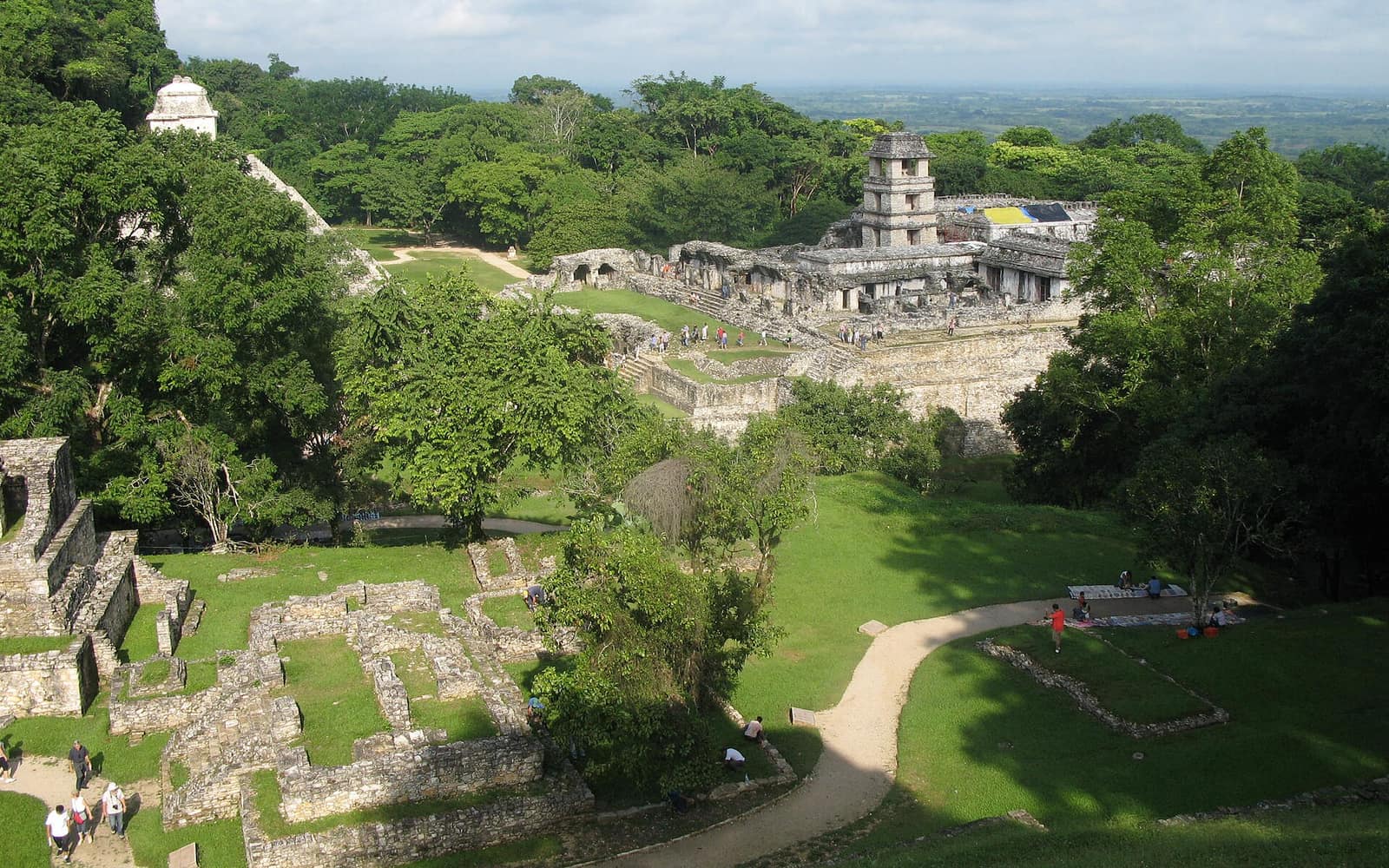
The core of Palenque is compact and astonishingly complete. The Temple of the Inscriptions is a nine-level pyramid named for the long hieroglyphic text on its summit, 617 glyphs across three panels, one of the longest known in the Maya world. Facing it, the Palace sprawls across a raised platform of courtyards, galleries, and underground passages, crowned by a four-story tower that later rulers may have used to watch the sky.
Just beyond stand the temples of the Cross Group, three graceful shrines with steep roofs and openwork combs that once carried painted plaster. Palenque's builders were masters of the corbel vault and of stucco relief, and the lightness of their sculpture, faces and gods and processions modeled in fine plaster, is what sets the city apart. Water runs everywhere. Engineers channeled the springs into aqueducts, including what may be the oldest pressurized water conduit known in the Americas.
Why it is sacred
For the Maya, Palenque's temples mapped the cosmos. The tablets inside the Cross Group, dedicated by Kan Bahlam II in 690 CE, tell the birth stories of the city's three patron gods, the Palenque Triad, binding the ruling dynasty to the makers of the world.
The Tablet of the Foliated Cross shows the first maize plant splitting into branches, its ears replaced by human heads, an image of the Maya belief that people were formed from corn. Pakal's own sarcophagus lid casts him as the maize god reborn and the rising sun. These are not dead symbols. The Maya are a living people, and their descendants still farm, speak, and hold ceremony across Chiapas and the wider Maya world.
Standing there today
Palenque rewards an early arrival. Mist hangs in the trees, howler monkeys growl overhead, and the pale temples glow against deep green. Trails lead past smaller groups and a forest waterfall on the way to the site museum, which holds carved panels and treasures connected to Pakal's tomb.
Less than a tenth of the city has been excavated. More than a thousand buildings still sleep under the canopy, so much of what you feel here is the forest itself, holding the rest.
Did you know
- Pakal was the longest-reigning monarch in the recorded history of the Americas, on the throne for roughly sixty-eight years.
- Fringe writers once claimed the carved sarcophagus lid showed an ancient astronaut in a spacecraft, but Maya scholars read it as Pakal reborn as the maize god.
- Palenque's engineers built what may be the oldest known pressurized aqueduct in the Americas, feeding baths and pools inside the Palace.
- The ancient Maya name Lakamha means roughly big water, for the streams and springs running through the site.
- Pakal came to the throne as a boy of about twelve, with his mother, Lady Sak K'uk', ruling as regent in his place.
- The Temple of the Inscriptions holds one of the longest hieroglyphic texts in the Maya world, 617 glyphs carved across three stone panels.
- Less than ten percent of the city has been excavated, leaving over a thousand buildings hidden in the rainforest.
Through time
- c. 226 BCE First settlement takes root at Lakamha in the Chiapas forest.
- 431 CE K'uk' Bahlam I founds Palenque's ruling dynasty.
- 615 CE K'inich Janaab' Pakal accedes to the throne as a boy.
- 683 CE Pakal dies and is entombed in the Temple of the Inscriptions.
- 690 CE Kan Bahlam II dedicates the temples of the Cross Group.
- c. 900 CE The city is abandoned and the rainforest reclaims it.
- 1952 Alberto Ruz Lhuillier reaches Pakal's hidden tomb.
Before you go
The gateway is the town of Palenque in northern Chiapas, reachable by ADO bus or by air via Villahermosa, roughly two hours away, and a small local airport. The ruins lie about 8 km southwest of town, an easy shared colectivo or taxi ride.
Come in the dry season, roughly November to April, when the trails are firmer and the heat is kinder. Arrive at opening to beat the crowds and to catch the morning mist and howler monkeys.
Allow at least half a day. Three to four hours covers the main groups, and a full day lets you add the site museum, the forest trails, and the waterfalls.
This is a living Maya landscape, not just a ruin. Stay on marked paths, do not climb roped-off temples or touch the carvings, keep your voice low near the tombs, and ask before photographing local Maya vendors or any ceremony.
Sources: UNESCO World Heritage Centre, Pre-Hispanic City and National Park of Palenque · INAH, Palenque Archaeological Zone · Smithsonian NMAI, Living Maya Time: Palenque · National Geographic, Pakal the Great and the city of Palenque · Wikipedia, Palenque
Nearby & related
The vast city of pyramids the Aztecs later called “the place where the gods were created.”
Ancient · State of México Chichén ItzáThe Maya city whose pyramid still catches the equinox serpent of light on its steps.
Ancient · Yucatán Monte AlbánA Zapotec capital levelled from a ridge-top, floating above the valley of Oaxaca.
Ancient · Oaxaca TulumA walled Maya port on a limestone cliff above the Caribbean, and one of the last Maya cities still lived in when Spanish ships first passed by.
Ancient · Quintana Roo UxmalA Late Classic Maya capital in the dry Puuc hills, its limestone palaces covered in masks of the rain god Chaac.
Ancient · YucatánHold ceremony in Mexico?
Each vertical opens with a curation round: verified, or not listed. Tell us who you are, what you hold, and where we can check you.
For practitioners →