Ancient · Yucatán · Maya (later Maya-Toltec) · c. 600 – 1200 CE
Chichén Itzá
The Maya city whose pyramid still catches the equinox serpent of light on its steps.
UNESCO World Heritage · New7Wonders
For a few centuries Chichén Itzá was the great power of the northern Yucatán, a city of pyramids and ball courts raised on flat limestone with almost no rivers to speak of. Its builders read the sky closely and left the proof in stone. On the afternoons near the equinoxes, the terraces of its main pyramid still throw a rippling body of light down the stairway, and a carved serpent's head waits for it at the bottom.
The story
People settled around the cenotes here, the natural sinkholes that gave this dry country its only reliable water, well before the city we see took shape. By around 600 CE Chichén Itzá was growing into a regional capital, and over the next few centuries it became the dominant power across the northern Yucatán.
Its rulers were tied to a people called the Itzá, and they drew in ideas and trade from far beyond the Maya world. Buildings here echo the styles of Tula in central Mexico, and scholars have argued for over a century about whether that means conquest, migration, or simply a shared elite culture moving along the same trade routes. What is clear is that Chichén Itzá borrowed boldly and built at a scale few Maya cities matched.
By around 1100 to 1200 CE the city had faded as a political center and power in the region shifted elsewhere. It was never fully forgotten. Long after the great construction stopped, people kept coming to the Sacred Cenote to leave offerings.
What you are looking at
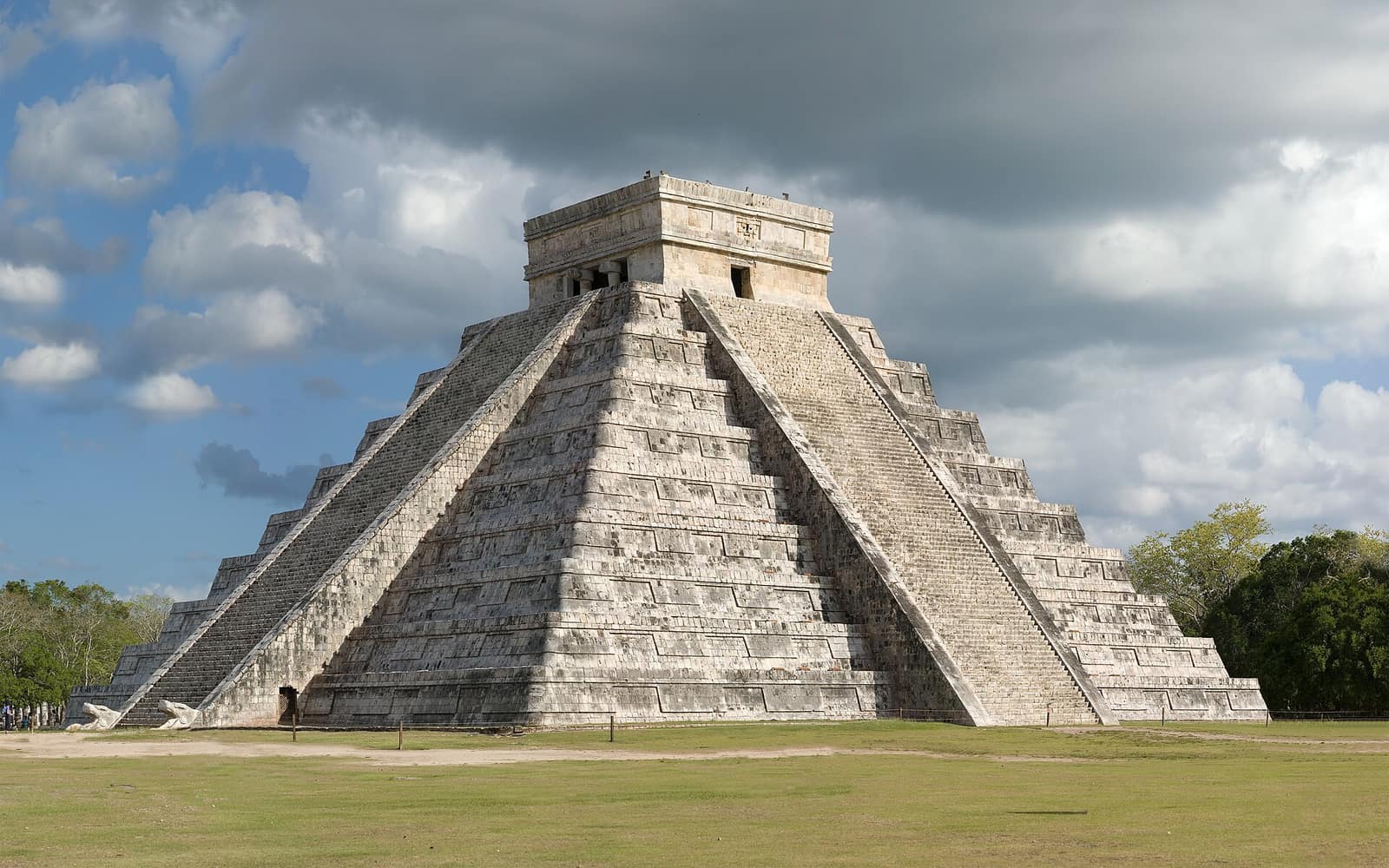
The building everyone photographs is El Castillo, the temple of Kukulcán, a feathered serpent god. It rises about 30 meters in nine stepped terraces, with a stairway climbing each of its four faces. Each stair holds 91 steps, and together with the platform at the top they add up to 365, the length of the solar year.
Around it stands a whole ceremonial city. The Great Ball Court is the largest in ancient Mesoamerica, about 168 meters long, its stone rings set high on the walls and its acoustics so sharp that a low voice carries the full length. The Temple of the Warriors fronts rows of carved columns and a reclining Chac Mool figure, and a nearby low platform once held a rack of skulls.
El Castillo hides its own history. Inside it sits an older pyramid, and within that a chamber holding a throne carved as a jaguar and painted red with cinnabar. In 2015 researchers even detected a cenote in the bedrock directly beneath the pyramid.
Why it is sacred
The whole city grew up around water in a land with almost no rivers. The Sacred Cenote, a sheer walled pool about 60 meters across, was never a drinking source. It was a doorway. The Maya understood cenotes as openings to the underworld and to the rain that their maize depended on.
For centuries people cast offerings into its green water: jade, gold, carved shell, copal incense, and the remains of people given to the well. Dredging and diving over the last hundred years have brought thousands of these objects back up, a record of devotion that outlasted the city's political life.
The sky in stone
The Maya were careful watchers of the sky, and Chichén Itzá is built to show it. The round tower called El Caracol, named for the spiral stair inside it, has windows and sightlines aimed at the setting points of Venus, the planet whose 584-day cycle governed much of the Maya calendar.
El Castillo carries the same instinct. On the afternoons around the spring and autumn equinoxes, the terraces cast a row of triangular shadows down one balustrade, so that a body of light seems to ripple down the stairway toward a carved serpent head at the base. Whether the builders planned the effect this exactly is debated, but the alignment is real, and thousands still gather to watch it.
Standing there today
Chichén Itzá is one of the most visited ancient sites in the Americas, drawing on the order of two and a half million people a year. It became a UNESCO World Heritage Site in 1988 and, in 2007, was voted one of the New Seven Wonders of the World.
Climbing the pyramids is no longer allowed, which keeps the stone intact and the crowds on the ground. Come early and the plazas are calm, the light is low, and it is easier to feel the scale of what the Itzá raised. For Yucatec Maya communities nearby, this is not a ruin but living heritage.
Did you know
- Each face of El Castillo has 91 steps; the four stairways plus the top platform total 365, one for every day of the solar year.
- The Great Ball Court is so precisely shaped that a low voice at one end carries clearly to the other, more than 130 meters away.
- Buried inside El Castillo is an older pyramid holding a throne carved as a jaguar and painted red with cinnabar, a mercury pigment.
- In 2015 researchers detected a hidden cenote in the bedrock directly beneath El Castillo, water the builders may have chosen to build over.
- Dredgers and divers have pulled gold, jade, copal incense, and human remains from the Sacred Cenote, thrown in as offerings over centuries.
- The round tower called El Caracol has windows aligned to the setting points of Venus, whose 584-day cycle the Maya tracked closely.
- The name means roughly 'at the mouth of the well of the Itzá,' after the ruling people and the cenotes that let the city survive.
Through time
- c. 600 CE Settlement around the cenotes grows into a regional center
- c. 832 CE Earliest known carved date at the site as the Itzá rise to power
- c. 900 to 1000 CE Peak building program: El Castillo, the Ball Court, the Warriors
- c. 1100 to 1200 CE City fades as a political capital; regional power shifts away
- 1904 to 1910 Edward Thompson dredges the Sacred Cenote for its offerings
- 1988 Inscribed as a UNESCO World Heritage Site
- 2007 Voted one of the New Seven Wonders of the World
Before you go
Most visitors come by road from Mérida (about 120 km, 1.5 hours), Valladolid (about 43 km, 35 minutes), or Cancún and the Riviera Maya (roughly 2 to 2.5 hours). Since 2024 the Tren Maya also stops near Pisté, about 3 km from the gate, with taxis and colectivos for the last stretch.
Arrive right at the 8 am opening to walk the site before the tour buses and the midday heat. The spring and autumn equinoxes draw big crowds for the serpent of light, so pick an ordinary day if you want room to breathe.
Plan on about 2 to 4 hours to take in El Castillo, the Great Ball Court, the Temple of the Warriors, El Caracol, and the Sacred Cenote at a steady pace.
Climbing El Castillo and the other pyramids is no longer permitted, so admire them from the ground. Bring water, sun cover, and cash in pesos for the two separate entry fees, and treat the place as the living Maya heritage it remains.
Sources: UNESCO World Heritage Centre: Pre-Hispanic City of Chichen-Itza · INAH: Chichén Itzá · Encyclopaedia Britannica: Chichen Itza · Wikipedia: Chichen Itza · Wikipedia: El Caracol, Chichen Itza · The Metropolitan Museum of Art: Offerings from the Sacred Cenote
Nearby & related
The vast city of pyramids the Aztecs later called “the place where the gods were created.”
Ancient · State of México Monte AlbánA Zapotec capital levelled from a ridge-top, floating above the valley of Oaxaca.
Ancient · Oaxaca PalenqueThe rainforest Maya city of Pakal, where fine stone temples meet the jungle canopy.
Ancient · Chiapas TulumA walled Maya port on a limestone cliff above the Caribbean, and one of the last Maya cities still lived in when Spanish ships first passed by.
Ancient · Quintana Roo UxmalA Late Classic Maya capital in the dry Puuc hills, its limestone palaces covered in masks of the rain god Chaac.
Ancient · YucatánHold ceremony in Mexico?
Each vertical opens with a curation round: verified, or not listed. Tell us who you are, what you hold, and where we can check you.
For practitioners →