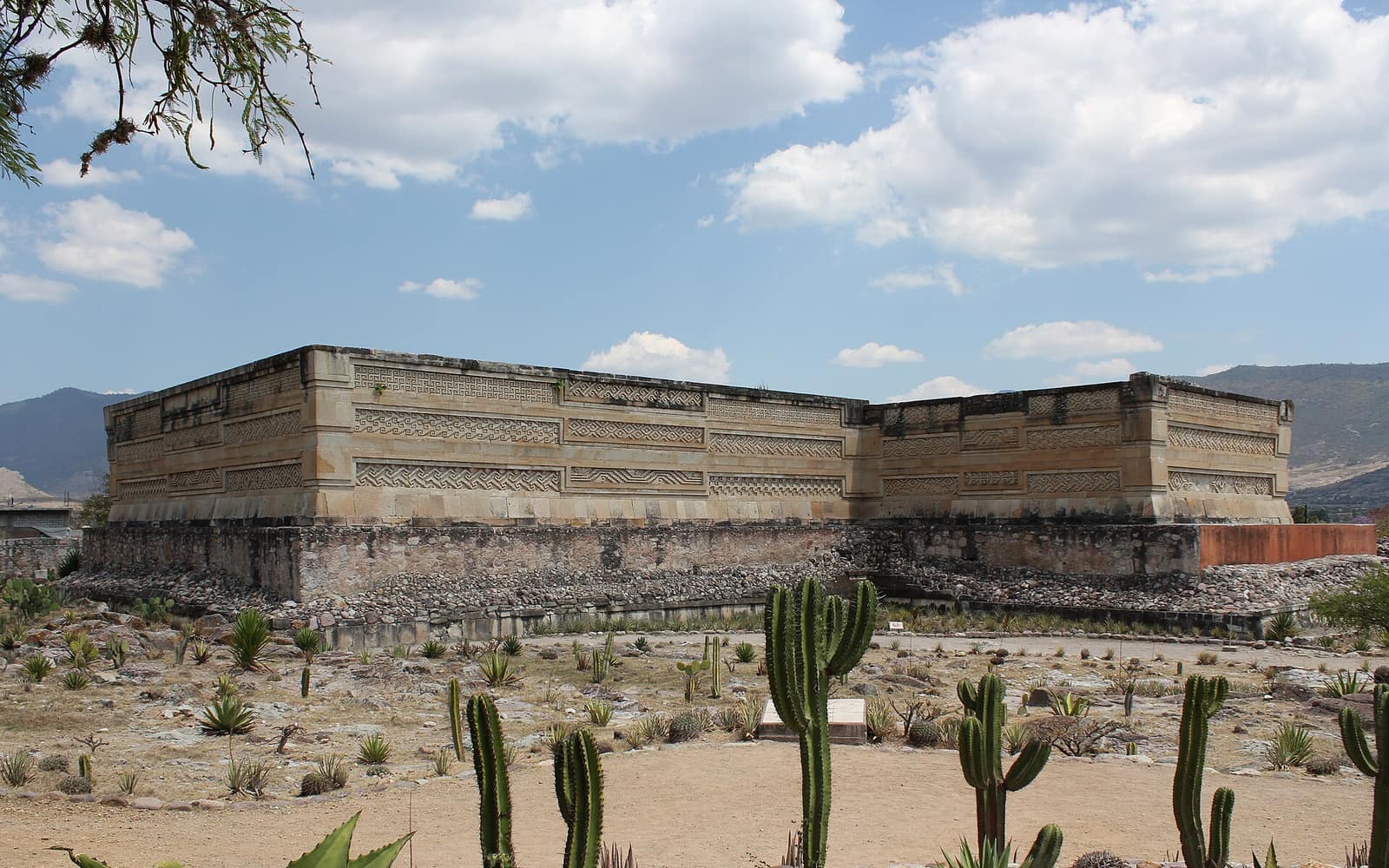
Ancient · Oaxaca · Zapotec, with later Mixtec influence · settled c. 200 CE, at its height around 1200 CE
Mitla
A Zapotec city of the dead in Oaxaca, walled in stone mosaic fretwork found nowhere else in Mesoamerica.
Federal archaeological zone protected by INAH, part of the UNESCO-listed Yagul and Mitla cultural landscape (2010)
An hour southeast of Oaxaca, in a valley of mezcal and weavers, stands a city the Zapotec built for the dead. Its palace walls are sheathed in stone mosaic so precise it looks woven. Beneath the colonial church that crowns the site lie the sealed passages they called Lyobaa, the resting place.
The story
Zapotec groups settled here by about 200 CE, in the upper Tlacolula valley. As Monte Albán declined in the 9th century, Mitla grew into the leading religious center of the region, and it reached its height around 1200 CE.
By then Mixtec people had a strong presence in the valleys, and their hand shows in the architecture and the painted friezes. Mitla held its authority over the Tlacolula valley until the Spanish arrived in the 1520s.
What you are looking at
The surviving monuments are laid out in five groups, most built as pairs of courtyards ringed by long halls. The finest is the Group of the Columns, named for the row of monolithic stone pillars in its main hall.
Every wall is faced with grecas, geometric fretwork assembled from thousands of small cut stones set into the masonry without mortar. The pieces hold by fit alone, and no panel repeats another exactly. Mitla is often described as the only place in Mesoamerica where this mosaic covers whole facades rather than a single decorative band.
Why it is sacred
The names say it plainly. In Nahuatl the site is Mictlan, the place of the dead, and in Zapotec it is Lyobaa, the resting place. Mitla was a burial ground for rulers, nobles, and high priests, with cruciform tombs cut beneath the palaces.
According to tradition, the caverns under the site opened onto the underworld, tended by a high priest the Zapotec regarded as a mouth of the gods. People came here to bury their dead and, the accounts hold, to sit closer to the world below.
The church on the tombs
In the 16th century the Spanish raised the church of San Pablo on top of a pre-Hispanic platform, reusing the ancient stone. The colonial sanctuary and the Zapotec mosaics now stand side by side, one built to bury the other.
In 1674 the Dominican friar Francisco de Burgoa wrote that missionaries had entered a vast underground chamber below the site and, disturbed by it, ordered the entrance walled up. In 2022 a team using ground penetrating radar and other scans, the Lyobaa Project, mapped real voids and passages beneath the church, matching the old descriptions.
Standing there today
Mitla is an easy day trip from Oaxaca, often paired with the petrified falls at Hierve el Agua and the weaving town of Teotitlán del Valle. The archaeological zone sits within the modern town of San Pablo Villa de Mitla, still Zapotec-speaking and known for its textiles and mezcal.
You can walk right up to the fretwork and into the courtyards, which makes the craftsmanship easy to read up close. This is a cemetery as much as a monument, so it rewards a slow, quiet visit.
Did you know
- The name comes from the Nahuatl Mictlan, the place of the dead, while the Zapotec called it Lyobaa, the resting place.
- The mosaic panels are built from thousands of small cut stones set without mortar, and no two panels repeat one another exactly.
- Mitla is often cited as the only site in Mesoamerica where this fretwork sheathes entire building facades rather than a narrow border.
- In 1674 the Dominican chronicler Francisco de Burgoa recorded that missionaries entered a huge cavity beneath the site and had its gate walled up.
- A 2022 geophysical survey found large voids and passages under the colonial church, consistent with the sealed labyrinth of the old accounts.
- Some of the halls kept painted friezes in Mixtec codex style, and traces of red pigment still cling to a few of the stones.
Through time
- c. 200 CE Zapotec groups settle the site they call Lyobaa.
- 9th century Mitla rises as Monte Albán declines.
- c. 1200 CE The city reaches its height as a religious center, under Mixtec influence.
- 16th century The Spanish build the church of San Pablo over the ruins.
- 1674 Friar Burgoa describes the underground chamber and has it sealed.
- 2010 UNESCO lists the Yagul and Mitla cultural landscape.
- 2022 The Lyobaa Project maps voids beneath the church.
Before you go
Mitla is 44 km southeast of Oaxaca city in the Tlacolula valley. Shared colectivos and second-class buses run from Oaxaca to San Pablo Villa de Mitla in about an hour, and many tours pair it with Hierve el Agua and Teotitlán del Valle.
Weekday mornings are quietest, and the early light on the mosaics is best. The dry months from roughly November to April are the most comfortable, though the days around Day of the Dead are atmospheric and crowded.
Allow one to two hours for the archaeological zone, or half a day if you add the town, its weavers, and a mezcal tasting.
This is both a burial ground and a living town. Keep to the marked paths, do not climb on the mosaics or enter roped-off tombs, and ask permission before photographing residents.
Sources: INAH, Zona Arqueológica de Mitla · UNESCO, Prehistoric Caves of Yagul and Mitla · Wikipedia, Mitla · INAH, subterranean survey of Lyobaa · Smithsonian Magazine, Zapotec underworld entrance
Nearby & related
The vast city of pyramids the Aztecs later called “the place where the gods were created.”
Ancient · State of México Chichén ItzáThe Maya city whose pyramid still catches the equinox serpent of light on its steps.
Ancient · Yucatán Monte AlbánA Zapotec capital levelled from a ridge-top, floating above the valley of Oaxaca.
Ancient · Oaxaca PalenqueThe rainforest Maya city of Pakal, where fine stone temples meet the jungle canopy.
Ancient · Chiapas Hierve el AguaPetrified “waterfalls” of mineral springs, a Zapotec bathing and ritual site for millennia.
Nature · OaxacaHold ceremony in Mexico?
Each vertical opens with a curation round: verified, or not listed. Tell us who you are, what you hold, and where we can check you.
For practitioners →