Ancient · Mexico City · Mexica (Aztec) · c. 1325 to 1521 CE
Templo Mayor
The great twin temple at the heart of the Aztec capital, buried under Mexico City for centuries and brought back to light in 1978.
Federal archaeological zone (INAH), within the UNESCO-listed Historic Centre of Mexico City
Two flights of stairs once climbed a painted pyramid to two temples, one for war, one for rain. The Spanish tore it down and built a city on top. Then in 1978 an electric crew dug into a carved stone goddess, and the heart of the Aztec world rose back into daylight.
The story
The Mexica founded Tenochtitlan on a marshy island around 1325, and the first shrine on this spot went up soon after. As the city grew into the dominant power of central Mexico, so did its temple. Successive rulers enlarged it, each rebuilding encasing the last, so the pyramid you see is really seven temples stacked inside one another.
In 1487 the ruler Ahuitzotl reconsecrated a vastly expanded temple in a dedication that lasted several days. Human sacrifice was central to the rites here, understood by the Mexica as the debt that kept the sun moving and the rains coming. When Hernán Cortés and his allies took the city in 1521, they pulled the temple down and raised the Spanish capital over the rubble.
What you are looking at
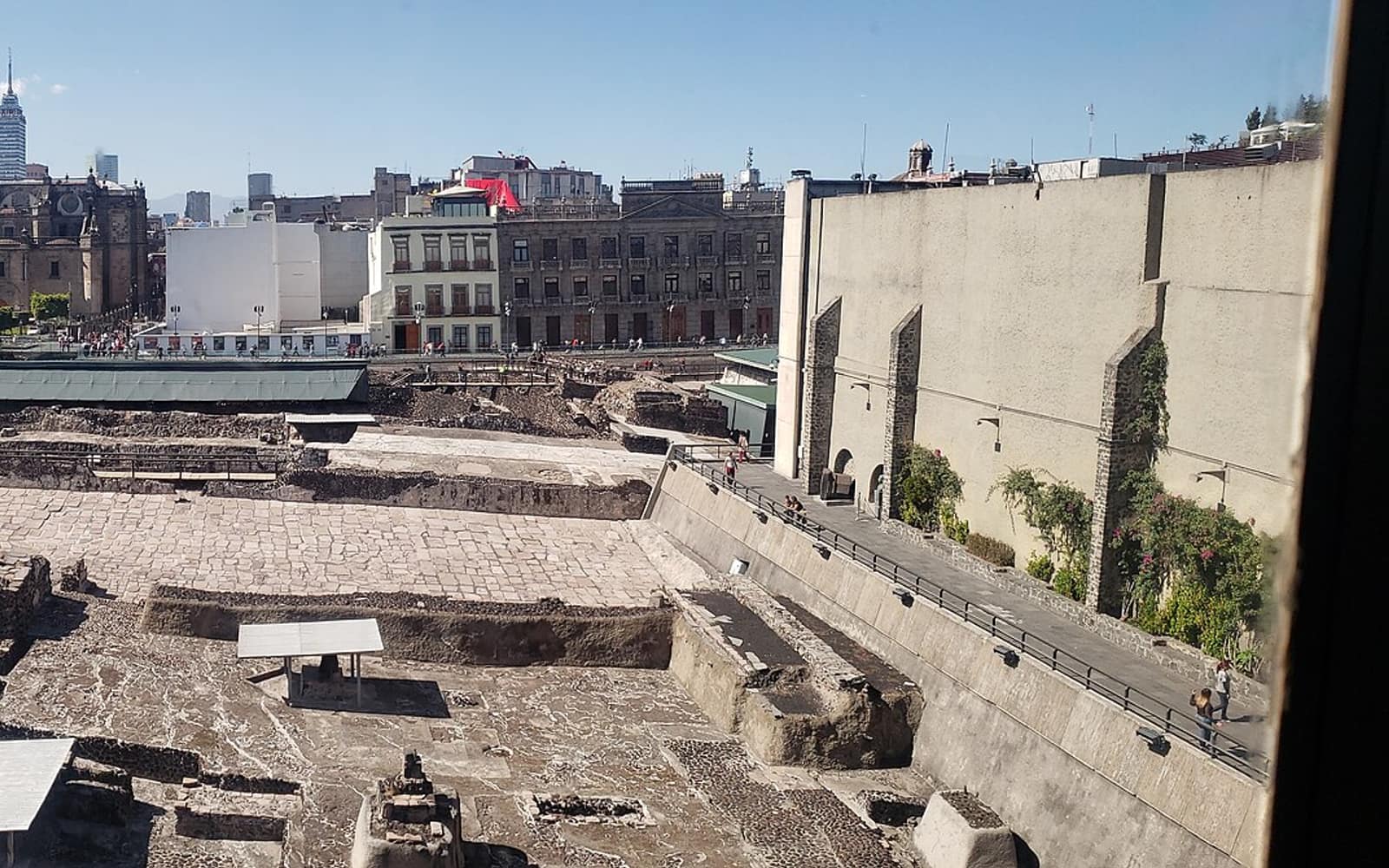
The exposed ruins are the lower platforms and stairways of those stacked pyramids, not the tall summit, which was destroyed. On the south side stood Huitzilopochtli's shrine, on the north side Tlaloc's, each reached by its own staircase. Fragments of the original stucco, serpent heads, and a rack for skulls still mark the ground.
Around and beneath the platforms, archaeologists have lifted more than 200 sealed offering caches. They hold jade, shells, coral, jaguar and eagle remains, obsidian, and objects carried in from far corners of Mesoamerica, buried as gifts to the two gods.
The Coyolxauhqui stone
On 21 February 1978 electricity workers digging behind the cathedral struck a huge carved disk, about 3.25 metres across. It showed Coyolxauhqui, the moon goddess, beheaded and dismembered, her limbs splayed around the stone.
The image retells a founding myth. Coyolxauhqui led her brothers against their mother Coatlicue, and Huitzilopochtli sprang out fully armed to defend her, killing his sister and throwing her broken body down the mountain. The disk lay at the foot of Huitzilopochtli's stairway, so victims cast down the steps fell onto the same fate as the goddess. The find set off the Templo Mayor Project under Eduardo Matos Moctezuma, one of the great excavations of the twentieth century.
Why it is sacred
For the Mexica the temple was not one mountain but two. Huitzilopochtli's side stood for Coatepec, the Serpent Mountain where he was born in battle. Tlaloc's side stood for the Hill of Sustenance, the source of water and maize.
Together they made the temple the centre of the universe, the fixed point from which the four directions and the layers of sky and underworld unfolded. Ceremonies here were meant to hold that order in place. To stand at the base is to stand where the Mexica believed the world was anchored.
Standing there today
Raised metal walkways carry you over the layered platforms, close to the serpent heads and the altars. The path leads into the site museum, arranged in two halves that echo the twin dedication, with the Coyolxauhqui disk and the colossal Tlaltecuhtli monolith among its centrepieces.
The setting is startling: Aztec stone below, the baroque cathedral and the modern square all around, five centuries pressed into one block of the city.
Did you know
- The Coyolxauhqui disk is about 3.25 metres wide and shows the moon goddess dismembered at the very foot of the war god's stairway.
- The pyramid was rebuilt at least seven times, each temple sealed inside the next like the rings of a tree.
- The famous Sun Stone and the Coatlicue statue surfaced near here in 1790, almost two centuries before the temple itself was excavated.
- In 2006 a stone slab of Tlaltecuhtli, the earth deity, weighing close to 12 tonnes was lifted from the site, one of the largest Aztec monoliths ever found.
- Offerings buried under the temple include coral, seashells, and animal remains brought from coasts and forests hundreds of kilometres away.
- The two summit shrines meant the Mexica saw a single pyramid as two sacred mountains at once, one for war and one for rain.
Through time
- c. 1325 CE The Mexica found Tenochtitlan and raise the first shrine on the site.
- 1487 CE Ahuitzotl reconsecrates a greatly enlarged temple in a days-long dedication.
- 1521 CE Spanish and allied forces raze the temple; the colonial city rises over it.
- 1790 CE The Sun Stone and the Coatlicue statue are unearthed nearby during works on the plaza.
- Feb 1978 Electricity workers strike the Coyolxauhqui disk, launching the Templo Mayor Project.
- 1987 CE The site museum opens beside the excavated ruins.
- 2006 CE A monumental Tlaltecuhtli earth-goddess monolith is uncovered at the site.
Before you go
In the Centro Histórico, a short walk northeast of the Zócalo and just behind the Metropolitan Cathedral. Metro Zócalo (Line 2) leaves you a couple of minutes away.
Open Tuesday to Sunday. Go early on a weekday to beat crowds and the midday sun; the exposed walkways offer little shade.
Allow around two hours to walk the ruins and take in the museum properly.
This is a sacred centre of a living culture, not just ruins. Stay on the walkways, do not touch or climb the stonework, and photograph offerings and human remains with respect.
Sources: INAH - Zona Arqueológica Templo Mayor · Templo Mayor - Wikipedia · Coyolxauhqui Stone - Wikipedia · Templo Mayor - World History Encyclopedia · The Templo Mayor and the Coyolxauhqui Stone - Smarthistory · Tenochtitlan: Templo Mayor - The Metropolitan Museum of Art
Nearby & related
The vast city of pyramids the Aztecs later called “the place where the gods were created.”
Ancient · State of México Chichén ItzáThe Maya city whose pyramid still catches the equinox serpent of light on its steps.
Ancient · Yucatán Monte AlbánA Zapotec capital levelled from a ridge-top, floating above the valley of Oaxaca.
Ancient · Oaxaca PalenqueThe rainforest Maya city of Pakal, where fine stone temples meet the jungle canopy.
Ancient · Chiapas Basílica de GuadalupeThe most visited Catholic shrine in the Americas, on a hill that was sacred long before it.
Sanctuaries · Mexico CityHold ceremony in Mexico?
Each vertical opens with a curation round: verified, or not listed. Tell us who you are, what you hold, and where we can check you.
For practitioners →