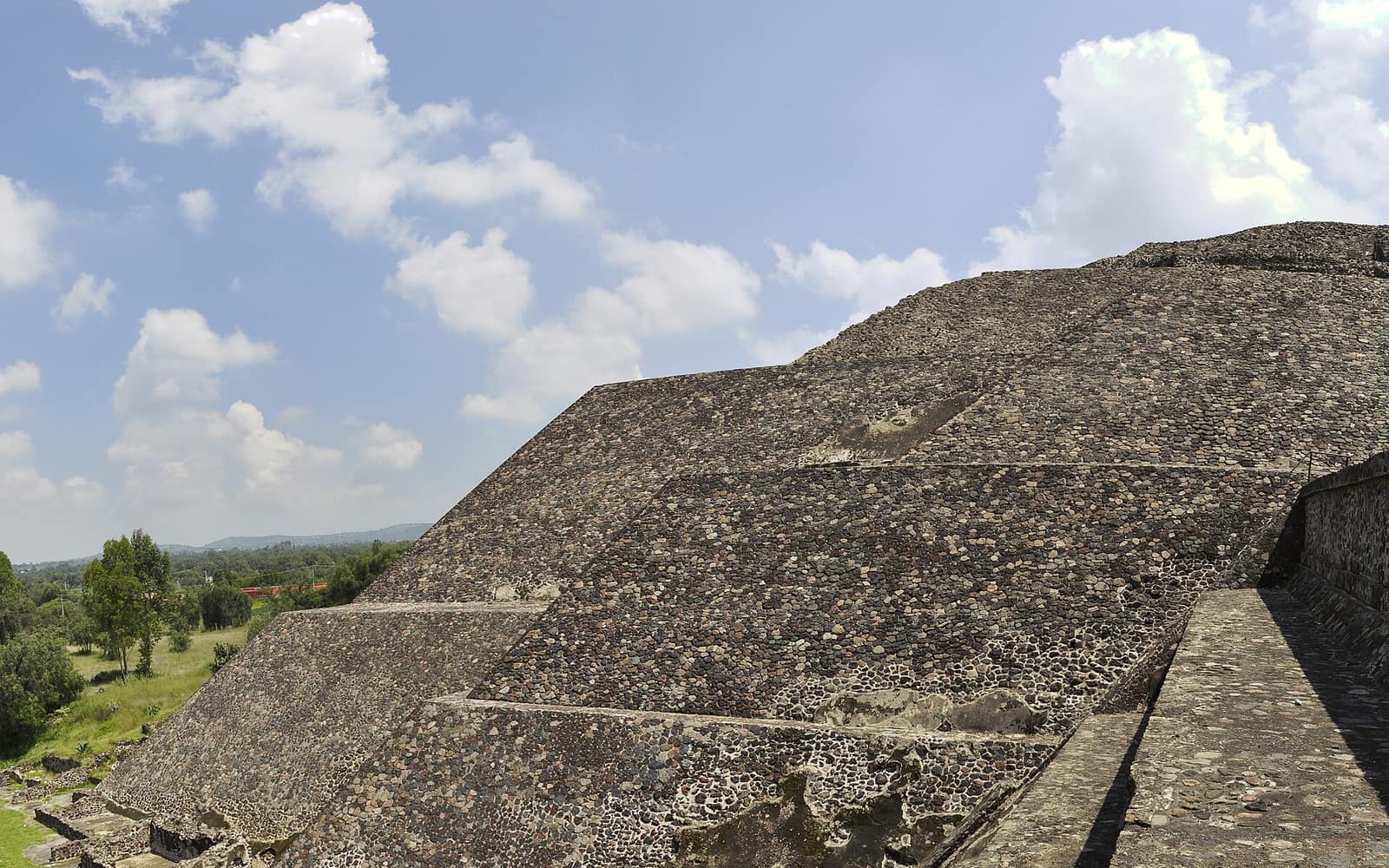
Ancient · State of México · Teotihuacano · c. 100 BCE – 550 CE
Teotihuacán
The vast city of pyramids the Aztecs later called “the place where the gods were created.”
UNESCO World Heritage · INAH zone
Long before the Aztecs, someone built a city of pyramids here so vast and so exactly planned that its origins still puzzle archaeologists. Its founders left no name, no king lists, and no writing anyone has learned to read. When the Aztecs came upon the silent ruins centuries later, they decided this could only be the place where the gods created the sun and the moon.
The story
The first farmers settled this stretch of the Valley of Mexico centuries before the common era, but the city proper took shape around 100 BCE. Within a few generations it exploded into something the ancient Americas had never seen: a planned metropolis of straight avenues, pyramids, and tens of thousands of people. By roughly 450 CE it may have held between 125,000 and 200,000 residents, ranking it among the largest cities on earth at the time.
It was also strikingly cosmopolitan. Whole neighborhoods housed migrants from distant regions, including a Zapotec quarter with people from Oaxaca and a district linked to the Maya world, each keeping its own pottery and burial customs. Obsidian workshops turned out blades and tools traded far across Mesoamerica.
Then it broke. Around 550 CE the ceremonial heart of the city was deliberately burned, its temples and elite dwellings set alight in a way that looks less like invasion than internal upheaval. The population drained away over the following century. When wandering Aztecs found the overgrown ruins some six hundred years later, they gave the dead city the name we still use, Teotihuacan, and treated it as holy ground.
What you are looking at
Everything lines up along one great axis, the Avenue of the Dead, a broad ceremonial street running roughly four kilometers between rows of platforms and plazas. The Aztecs assumed the mounds along it were tombs, hence the grim name, though most were temples.
At the north end rises the Pyramid of the Moon, set against the mountain that echoes its silhouette. Midway stands the Pyramid of the Sun, about 65 meters tall and one of the largest pyramids ever raised, built without mortar, wheels, or metal tools. To the south sits the walled Ciudadela and the Temple of the Feathered Serpent, its facade studded with stone serpent heads emerging from carved feathers.
Spread out around these monuments are the remains of hundreds of apartment compounds where ordinary families lived, many still holding painted murals of jaguars, priests, and a great goddess in reds and golds.
Why it is sacred
For the Aztecs, Teotihuacan was where time itself began. In their telling of the Fifth Sun, the gods gathered here in darkness around a fire to decide who would become the sun. A humble, sore-covered god named Nanahuatzin threw himself into the flames without hesitation, and rose reborn as the sun. A wealthier god followed and became the moon. The current age of the world, in this belief, was lit from this very place.
The name itself carries that weight. In Nahuatl it is usually read as the place where the gods were created, or the birthplace of the gods. Aztec rulers made pilgrimages here and collected its relics, honoring a city that was already ancient and anonymous to them.
That sense of the sacred has never fully left. Each spring equinox, tens of thousands of people come dressed in white to raise their arms toward the rising sun, an observance that blends indigenous memory with modern devotion.
The unanswered questions
For all its scale, the city keeps its secrets. Its people left no readable script, no list of kings, and no clear word for who they were, so we do not know what language they spoke or what they called themselves.
The ground still surprises. Beneath the Temple of the Feathered Serpent, archaeologists have traced a sealed tunnel running about a hundred meters, its chambers packed with tens of thousands of offerings: jade figures, pyrite mirrors, carved shells, and even pools of liquid mercury, likely a symbolic river to the underworld. In the temple's foundations lie the remains of more than two hundred people who were sacrificed and buried, many with their hands bound.
Even the street grid is a riddle. The whole city tilts about 15.5 degrees east of true north, an angle that may track the setting point of the Pleiades and tie the plan of the city to the movements of the sky.
Standing there today
Walking the Avenue of the Dead, the first thing you feel is size. The pyramids read as hills until you stand at their base and start counting steps. Morning light and thin crowds make the early hours the best time to take it in.
The rules have changed in recent years. To protect the monuments, the Pyramid of the Sun is now closed to climbing, and the Pyramid of the Moon reopened only partway in 2025, with access limited to its lower platform. You can still climb enough to look out over the whole aligned city and the valley beyond.
Did you know
- The Aztecs arrived roughly six hundred years after the city fell, so it was they, not its builders, who named it and made pilgrimages to it.
- Archaeologists found pools of liquid mercury and tens of thousands of offerings inside a sealed tunnel beneath the Temple of the Feathered Serpent.
- The entire city is tilted about 15.5 degrees off true north, an angle that may follow the setting of the Pleiades.
- More than two hundred people were sacrificed and buried in the foundations of the Feathered Serpent temple, many with their hands tied.
- Its builders left no writing anyone can read, no king lists, and no record of what they called themselves.
- Neighborhoods of Zapotec and Maya migrants lived here, making it one of the most cosmopolitan cities of the ancient Americas.
- The Pyramid of the Sun rises about 65 meters and was raised without mortar, wheels, or metal tools.
Through time
- c. 100 BCE The city takes shape and monumental building begins
- c. 100 CE The Pyramid of the Sun is completed
- c. 200 CE Temple of the Feathered Serpent built over mass sacrifices
- c. 450 CE Peak of the city, among the largest on earth
- c. 550 CE The ceremonial center is burned and decline sets in
- c. 1400s CE Wandering Aztecs revere the ruins and give them their name
- 1987 CE Inscribed as a UNESCO World Heritage Site
Before you go
Buses to the pyramids leave roughly every fifteen minutes from Mexico City's Terminal Norte and reach the site in about an hour. Entry runs around 100 pesos, cash only.
Come at opening, around 8 to 9 am, for cool air and smaller crowds. The March spring equinox draws tens of thousands dressed in white and is beautiful but very busy.
Allow three to four hours to walk the Avenue of the Dead from end to end and take in both great pyramids. A relaxed half day is comfortable.
The Pyramid of the Sun is closed to climbing and the Moon only partly open, so respect the barriers that protect the monuments. Bring water, sun protection, and a hat, and treat equinox gatherings as living observances.
Sources: UNESCO World Heritage Centre, Pre-Hispanic City of Teotihuacan · Encyclopaedia Britannica, Teotihuacan · Wikipedia, Teotihuacan · Archaeology Magazine, Liquid Mercury Discovered Beneath Teotihuacan Pyramid · Wikipedia, Spring equinox in Teotihuacan · Mexico News Daily, Pyramid of the Moon reopens to climbers
Nearby & related
The Maya city whose pyramid still catches the equinox serpent of light on its steps.
Ancient · Yucatán Monte AlbánA Zapotec capital levelled from a ridge-top, floating above the valley of Oaxaca.
Ancient · Oaxaca PalenqueThe rainforest Maya city of Pakal, where fine stone temples meet the jungle canopy.
Ancient · Chiapas Basílica de GuadalupeThe most visited Catholic shrine in the Americas, on a hill that was sacred long before it.
Sanctuaries · Mexico City Tepoztlán & El TepoztecoA cliff-ringed Pueblo Mágico with a mountaintop pyramid and a long reputation as an energy centre.
Energy · MorelosHold ceremony in Mexico?
Each vertical opens with a curation round: verified, or not listed. Tell us who you are, what you hold, and where we can check you.
For practitioners →