Ancient · Campeche · Maya (Kaan / Snake dynasty) · c. 500 BCE to c. 900 CE, peak in the 7th century
Calakmul
A vast Maya capital hidden in the Campeche jungle, once the seat of the Snake Kingdom that fought Tikal for control of the lowlands.
UNESCO Mixed World Heritage Site (2002, extended 2014); core of the Calakmul Biosphere Reserve
Deep in the forests of southern Campeche stands one of the largest cities the Maya ever built. For much of the Classic period Calakmul was the seat of the Snake Kingdom, a dynasty whose alliances and wars shaped the entire Maya lowlands. Today its great pyramids rise from an unbroken canopy that shelters more jaguars than anywhere else in Mexico.
The Snake Kingdom
The dynasty that ruled here called itself Kaan, the Snake. Its emblem, a snake head, appears on monuments across the Maya world, a measure of how far its influence spread. The Kaan line first ruled from Dzibanche to the north, and in the seventh century it made Calakmul the centre of its power.
Under Yuknoom Ch'een II, remembered as Yuknoom the Great, the Snake Kingdom reached its peak. Through marriage, patronage, and war it drew a long list of cities into its orbit and dominated the southern lowlands for much of the seventh century. Few Maya states before or after held comparable reach.
The war with Tikal
Calakmul's great rival was Tikal, and their contest ran for well over a century. It shaped Maya politics much as the struggle between Athens and Sparta shaped the ancient Mediterranean, with lesser cities forced to take a side.
In 562 the Snake kingdom and its allies defeated Tikal, opening a long stretch of Calakmul ascendancy. Tikal recovered, and in 695 it turned the tables, beating Calakmul in battle and capturing its king. Calakmul never fully regained its former dominance, and both cities faded in the collapse that followed.
What you are looking at
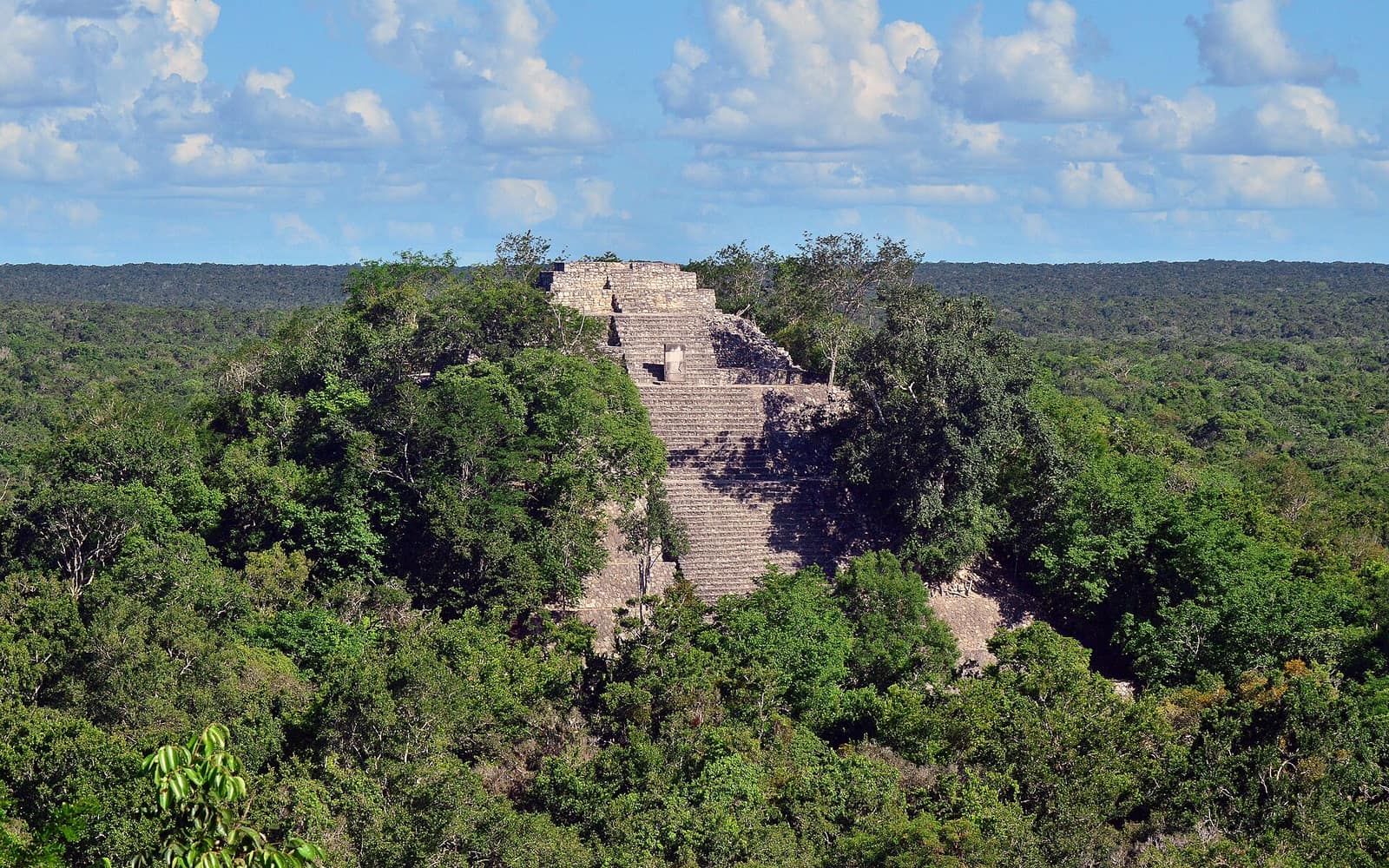
The name Calakmul, coined in the twentieth century, means roughly the city of two adjacent mounds, and its two great pyramids still dominate the site. Structure II, among the largest buildings the Maya ever raised, climbs more than 45 metres and holds royal tombs deep inside.
Around it archaeologists have mapped thousands of structures, from palaces and plazas to small platforms, and recorded 117 carved stelae, more than any other Maya city. In the Chiik Nahb complex, painted murals show ordinary people eating and trading, a rare glimpse of daily life rather than kings and gods.
The forest around it
The ruins sit at the core of the Calakmul Biosphere Reserve, the largest tract of tropical forest in Mexico and part of one of the largest surviving forests in the Americas. The jungle shelters the country's highest concentration of jaguars, along with tapirs, howler and spider monkeys, and hundreds of bird species.
In 2014 UNESCO joined the ancient city and its forest into one mixed World Heritage Site, recognising the cultural and the natural together rather than apart.
Standing there today
Getting to Calakmul takes effort, and the reward is a site almost free of crowds. Climb Structure II and the canopy runs unbroken in every direction, cut only by the crests of other pyramids and the calls of howler monkeys.
Standing above the trees, it is easy to feel the scale of the power that once ruled from here, and just as easy to see how completely the forest reclaimed it.
Did you know
- The modern name Calakmul was coined in 1931 and means roughly the city of two adjacent mounds; the Maya themselves knew the place as Ox Te' Tuun, the Three Stones.
- The ruling line called itself Kaan, the Snake dynasty, and its snake-head emblem turns up on monuments far from Calakmul, showing how wide its reach was.
- Calakmul rarely attacked Tikal head on, working instead through allies and vassals and encircling its rival the way a modern superpower runs proxy wars.
- Painted murals in the Chiik Nahb complex depict ordinary people eating, drinking, and selling food, a rare Maya image of daily market life.
- The site holds 117 carved stelae, the largest number recorded at any single Maya city.
- The surrounding jungle is home to the highest concentration of jaguars in Mexico.
Through time
- c. 500 BCE Settlement begins in the Preclassic period.
- 562 CE The Snake kingdom and its allies defeat Tikal.
- 636 CE The Kaan court centres its power at Calakmul; Yuknoom the Great reigns.
- 695 CE Tikal defeats Calakmul and captures its king, breaking its dominance.
- c. 830 CE Monument building ends as the city declines.
- 1931 CE Biologist Cyrus Lundell records the ruins from the air.
- 2002 / 2014 CE Listed by UNESCO, then extended to a mixed site.
Before you go
The site lies deep in the reserve, reached from Highway 186 by a turnoff near Conhuas and about 60 kilometres of narrow paved road. The nearest service town is Xpujil, roughly an hour to the east.
The dry season, roughly November to April, is easiest for the road and for climbing. Arrive early for cooler air, active wildlife, and the forest to yourself.
Allow a full day. The core needs two to three hours on foot, on top of the long drive in and out.
Stay on marked paths, take all litter out, and remove nothing from the site. This is a protected biosphere as much as a ruin, so keep noise down and give the wildlife space.
Sources: UNESCO World Heritage Centre, list 1061 · Wikipedia, Calakmul · INAH, Calakmul · National Geographic, the Maya Snake Kingdom · Wikipedia, Calakmul Biosphere Reserve
Nearby & related
The vast city of pyramids the Aztecs later called “the place where the gods were created.”
Ancient · State of México Chichén ItzáThe Maya city whose pyramid still catches the equinox serpent of light on its steps.
Ancient · Yucatán Monte AlbánA Zapotec capital levelled from a ridge-top, floating above the valley of Oaxaca.
Ancient · Oaxaca PalenqueThe rainforest Maya city of Pakal, where fine stone temples meet the jungle canopy.
Ancient · Chiapas TulumA walled Maya port on a limestone cliff above the Caribbean, and one of the last Maya cities still lived in when Spanish ships first passed by.
Ancient · Quintana RooHold ceremony in Mexico?
Each vertical opens with a curation round: verified, or not listed. Tell us who you are, what you hold, and where we can check you.
For practitioners →