Ancient · Quintana Roo · Lowland Maya · c. 50 BCE to 1550 CE, peak 600 to 900 CE
Cobá
A sprawling Maya city in the Quintana Roo jungle, hub of the ancient world's largest network of raised white stone roads.
Federal archaeological zone protected and managed by INAH
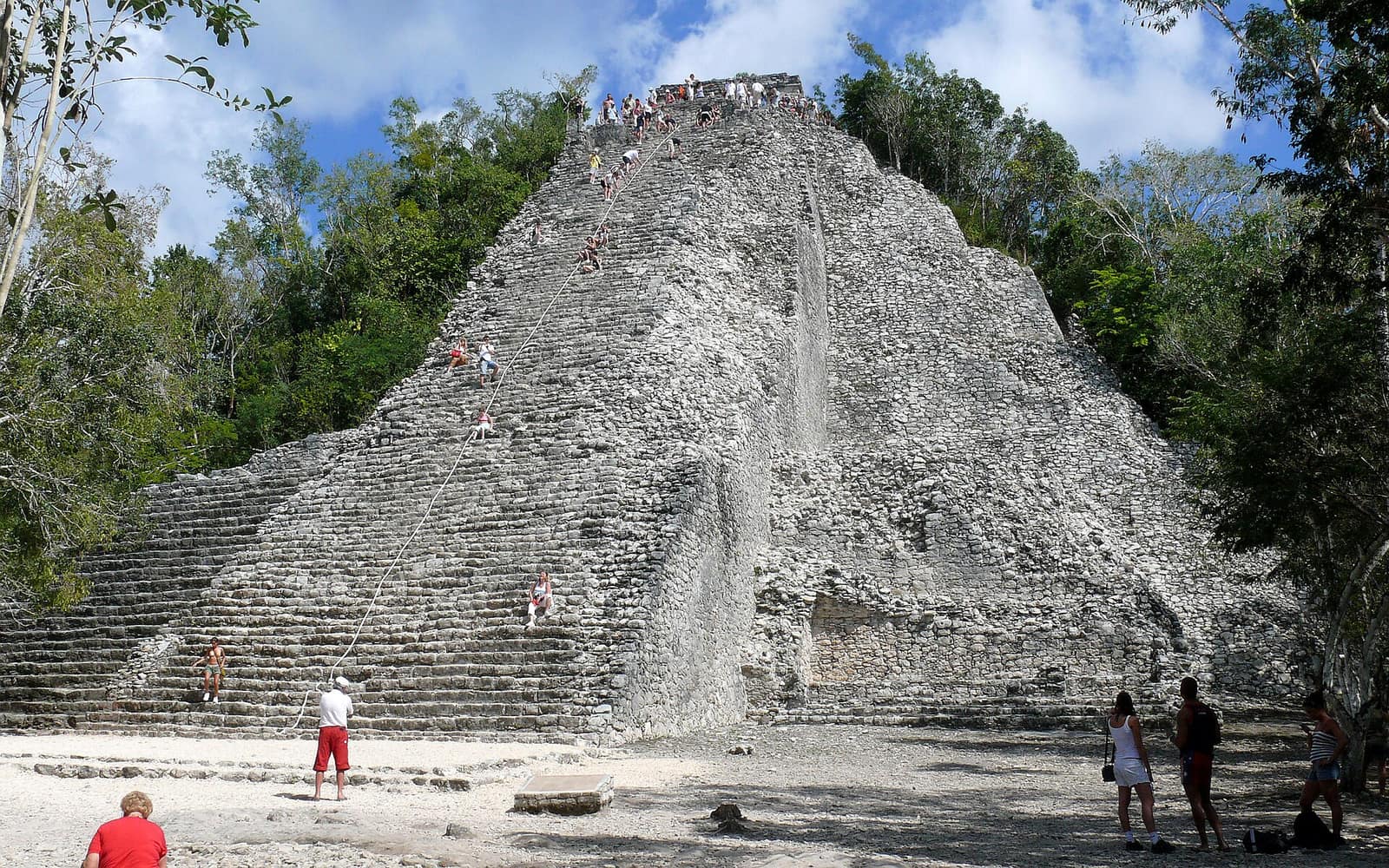
The jungle closes in the moment you pass the entrance, and the paths run long and straight between clearings. This was a city of roads: dozens of raised white causeways radiating out from the centre, one of them stretching more than a hundred kilometres. At the far end, above the canopy, rises Nohoch Mul, the tallest pyramid in the northern Yucatán.
The story
People settled between the lagoons of Cobá around two thousand years ago, and by the Late Classic period, from roughly 600 to 900 CE, the place had become a major power in the northern lowlands. It spread across some 80 square kilometres and may have held around 50,000 people.
Cobá's strength lay in trade and in its reach across the peninsula. After about 900 CE its influence faded as Chichén Itzá rose to the north. Building continued into the 1200s and 1400s, but the city stood largely abandoned by the time the Spanish reached the coast.
A city of white roads
The Maya called them sacbeob, the white roads. At Cobá at least 45 have been mapped, raised causeways of packed limestone rubble faced in white plaster, running dead straight through the forest. Some link the site's own groups; others reach distant towns.
The longest, known as Sacbe 1, runs more than 100 kilometres west to Yaxuná, near Chichén Itzá, and is the longest known Maya causeway. Nothing so extensive survives at any other site, which made Cobá the hub of the largest road network in the ancient Maya world.
What you are looking at
The ruins spread across several groups set among the trees and lagoons. The Cobá Group holds a pyramid and ball courts near the entrance; the Macanxoc Group, deeper in, is a cluster of stelae and altars; the Painted Group keeps traces of colour on its lintels.
At the far end stands Nohoch Mul, the great mound, a 42-metre pyramid that is the tallest on the northern Yucatán Peninsula and higher than El Castillo at Chichén Itzá. A steep flight of roughly 120 stone steps climbs to a small temple at the summit.
The carved record
Cobá's rulers set down their reigns on tall stone stelae, several of them clustered in the Macanxoc Group. The carvings are badly weathered now and sheltered under palm-thatch roofs, but they still preserve dates and dynastic history from the city's peak.
In 2020, researchers reading these monuments identified fourteen rulers of Cobá, at least one of them a woman thought to have governed in the city's early centuries. Direct evidence of a queen is rare in the Maya record, which makes Cobá's stelae unusual.
Standing there today
Cobá is spread out and quiet, more forest than plaza. The paths between groups run long enough that many visitors rent a bicycle or hire a pedal-taxi at the gate. Birds and howler monkeys are often louder than the crowds.
For years the climb up Nohoch Mul defined a visit, until INAH closed it in 2020 to protect the worn steps from heavy foot traffic. In December 2025 it reopened, with a wooden staircase laid over the ancient stone and access managed in small timed groups. Whether you climb or not, the barriers around the stelae and the marked paths keep the site standing.
Did you know
- The longest of Cobá's white roads runs more than 100 kilometres west to Yaxuná, the longest known causeway of the ancient Maya.
- Nohoch Mul is a modern Maya name meaning 'great mound'; the pyramid stands taller than El Castillo at Chichén Itzá.
- The name Cobá is usually read as 'waters stirred by wind', after the two lagoons the city sits between.
- In 2020, researchers reading Cobá's stelae identified fourteen rulers, at least one of them a woman.
- The staircase that reopened in 2025 is built from local tropical hardwoods, including tzalam, mahogany, and sapodilla, laid over the original stone.
- The site is so spread out that renting a bicycle or hiring a pedal-taxi is the usual way to see it.
Through time
- c. 50 BCE to 100 CE First settlement founded between the lagoons
- 600 to 900 CE Late Classic peak; up to ~50,000 people; stelae carved
- c. 900 to 1000 CE Regional power passes to Chichén Itzá
- c. 1200 to 1500 CE Late building, then abandonment before the Spanish
- 1893 CE Teobert Maler photographs the ruins
- 1972 to 1977 CE INAH excavations map the sacbeob network
- 2025 CE Nohoch Mul reopens to climbers on a new staircase
Before you go
Cobá sits about 45 kilometres inland from Tulum, roughly a 45-minute drive. Colectivos, buses, and organised tours run from Tulum and Playa del Carmen to the village at the site gate.
Come at opening, around 8am, to beat the heat and the tour crowds. The dry season, November to April, is the most comfortable time to walk the site.
Allow two to three hours. Because the groups are far apart, most people rent a bicycle or hire a pedal-taxi to cover the ground.
Stay on the marked paths, do not touch or climb the carved stelae, and follow the group size and time limits on the Nohoch Mul staircase.
Sources: Wikipedia: Cobá · INAH: Zona Arqueológica de Cobá · Britannica: Coba · Mexico News Daily: Nohoch Mul climbable again · Yucatán Magazine: Nohoch Mul reopens
Nearby & related
The vast city of pyramids the Aztecs later called “the place where the gods were created.”
Ancient · State of México Chichén ItzáThe Maya city whose pyramid still catches the equinox serpent of light on its steps.
Ancient · Yucatán Monte AlbánA Zapotec capital levelled from a ridge-top, floating above the valley of Oaxaca.
Ancient · Oaxaca PalenqueThe rainforest Maya city of Pakal, where fine stone temples meet the jungle canopy.
Ancient · Chiapas TulumA walled Maya port on a limestone cliff above the Caribbean, and one of the last Maya cities still lived in when Spanish ships first passed by.
Ancient · Quintana RooHold ceremony in Mexico?
Each vertical opens with a curation round: verified, or not listed. Tell us who you are, what you hold, and where we can check you.
For practitioners →