Sanctuaries · Guanajuato · Mexican Roman Catholic · 20th century, 1920s to 1950
Cristo Rey (Cerro del Cubilete)
A 20-metre bronze Christ the King crowns the Cerro del Cubilete, a Guanajuato hill long claimed as the geographic center of Mexico and rebuilt as a national pilgrimage site after the Cristero War.
Active Catholic sanctuary and major national pilgrimage site.
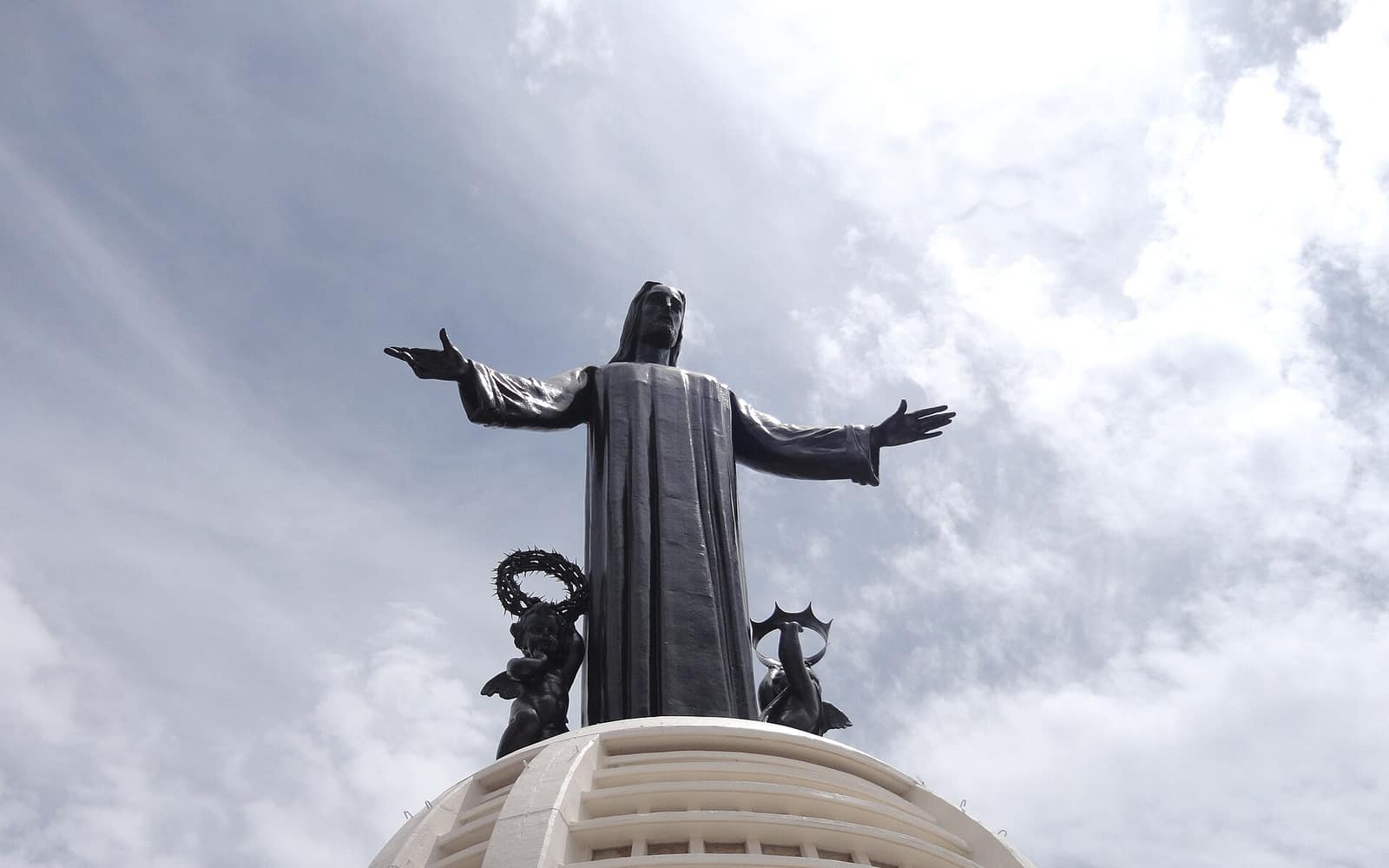
The road ends on a bald hilltop in the middle of the Bajío, and there he is: a 20-metre bronze Christ with open arms, standing on a globe above an eight-sided sanctuary. Pilgrims have come here for a century, through a monument dynamited in the Cristero War and rebuilt in bronze. The hill is even said to be the exact center of Mexico.
The story
Faith on this summit predates the statue you see. A small monument was raised and dedicated on the hill in 1920, and in 1923 the first stone of a much larger one was laid in a ceremony so charged that the Vatican's representative in Mexico was expelled from the country soon after.
That monument did not survive. In 1928, during the Cristero War, government forces dynamited it. Work on the present statue began in 1944 with the support of the bishop of León, and the bronze Christ was blessed in 1950. The sculptor was Fidias Elizondo of Monterrey, working on a base and sanctuary designed by the architect Nicolás Mariscal y Piña.
What you are looking at
The figure is a bronze Christ the King, arms outstretched, about 20 metres tall and close to 80 tonnes. He stands on a large sphere that stands for the universe, flanked by two angels who offer a crown of thorns and a royal crown.
The sphere sits on top of an octagonal sanctuary, so the whole monument rises well over 40 metres from the temple floor. It is often described as the largest bronze statue of Christ in the world, a claim you will hear locally and see repeated in guidebooks.
A Cristero symbol
The Cristero War, roughly 1926 to 1929, set Catholic communities across central and western Mexico against the anticlerical government of President Plutarco Elías Calles. The rebels' cry was Viva Cristo Rey, long live Christ the King, the same title honored on this hill.
That history is why the 1928 destruction of the earlier monument, and the decision to rebuild in bronze, still carry weight. For many visitors the statue is not only a shrine but a marker of that struggle and its cost.
The center-of-Mexico claim
The Cerro del Cubilete is popularly called the geographic center of Mexico, and the sanctuary leans into the idea. The claim goes back to 19th-century surveying that placed the country's midpoint near this peak. It is best treated as a well-loved tradition rather than a settled fact, since where you draw the center depends on how you measure the territory.
Standing there today
The hill rises to around 2,580 metres, and on a clear morning the view runs for miles across the Bajío toward León and Silao. A winding paved road brings cars, buses, and cyclists up to a car park below the summit, from where a short climb reaches the sanctuary.
Crowds swell on the Feast of Christ the King in late November and on the January anniversary of the site, when pilgrims arrive by the thousands. On ordinary days it is quiet, windswept, and open to anyone who makes the drive.
Did you know
- The hill's name, Cubilete, means dice cup, after its rounded, tumbling shape.
- The Cristero battle cry, Viva Cristo Rey, honors the same title given to the statue on this hill.
- When the earlier monument was destroyed in 1928, it was bombed from a military aircraft, and the sanctuary says the face and heart of the Christ were recovered and are kept in its museum.
- The bronze figure stands on a globe representing the world, with two angels offering a crown of thorns and a royal crown.
- It is often called the largest bronze statue of Christ in the world.
- Guanajuato's Del Bajío International Airport sits near the foot of the hill in Silao, so the statue is often the first landmark arriving travelers can pick out.
Through time
- 1920 A small monument is raised and dedicated on the summit
- 1923 First stone of a larger monument is laid on the hill
- 1926 The Cristero War breaks out across central Mexico
- 1928 The monument is dynamited by government forces
- 1944 Work begins on the current bronze Cristo Rey
- 1950 The 20 m bronze statue is blessed and inaugurated
Before you go
The summit sits about 20 km from Silao and 30 km from León, in the Bajío. A paved, winding road climbs to a car park below the sanctuary; buses and tours run from Guanajuato city and León, and Del Bajío International Airport (BJX) is at the foot of the hill.
Open year round, with mornings clearest for the long views over the Bajío. The Feast of Christ the King in late November and the January anniversary draw the largest pilgrim crowds.
One to two hours to walk up, see the sanctuary and terraces, and take in the panorama; easily paired with León or Guanajuato city.
This is a living sanctuary and pilgrimage site. Dress modestly, keep voices low inside the temple, and follow mass times and any photography limits near the altar.
Sources: Wikipedia: Cerro del Cubilete · Wikipedia: Cristo Rey (Silao) · Santuario de Cristo Rey, Historia · Guanajuato State tourism: Christ the King on Cubilete Hill · Desde la Fe: historia del Cristo del Cerro del Cubilete
Nearby & related
The most sacred land of the Wixárika people, endpoint of an ancient pilgrimage across the desert.
Sanctuaries · San Luis Potosí Basílica de GuadalupeThe most visited Catholic shrine in the Americas, on a hill that was sacred long before it.
Sanctuaries · Mexico City ChalmaA canyon shrine to a Black Christ that grew over an older cave cult, and Mexico's second most important pilgrimage site after Guadalupe.
Sanctuaries · State of México San Juan ChamulaA Tzotzil Maya town whose whitewashed church shelters a living religion practised on a floor of pine needles, by candlelight and copal smoke.
Sanctuaries · Chiapas IzamalA Maya holy city where a giant Franciscan convent sits on a flattened pyramid platform and Maya temples still rise between the streets.
Sanctuaries · YucatánHold ceremony in Mexico?
Each vertical opens with a curation round: verified, or not listed. Tell us who you are, what you hold, and where we can check you.
For practitioners →