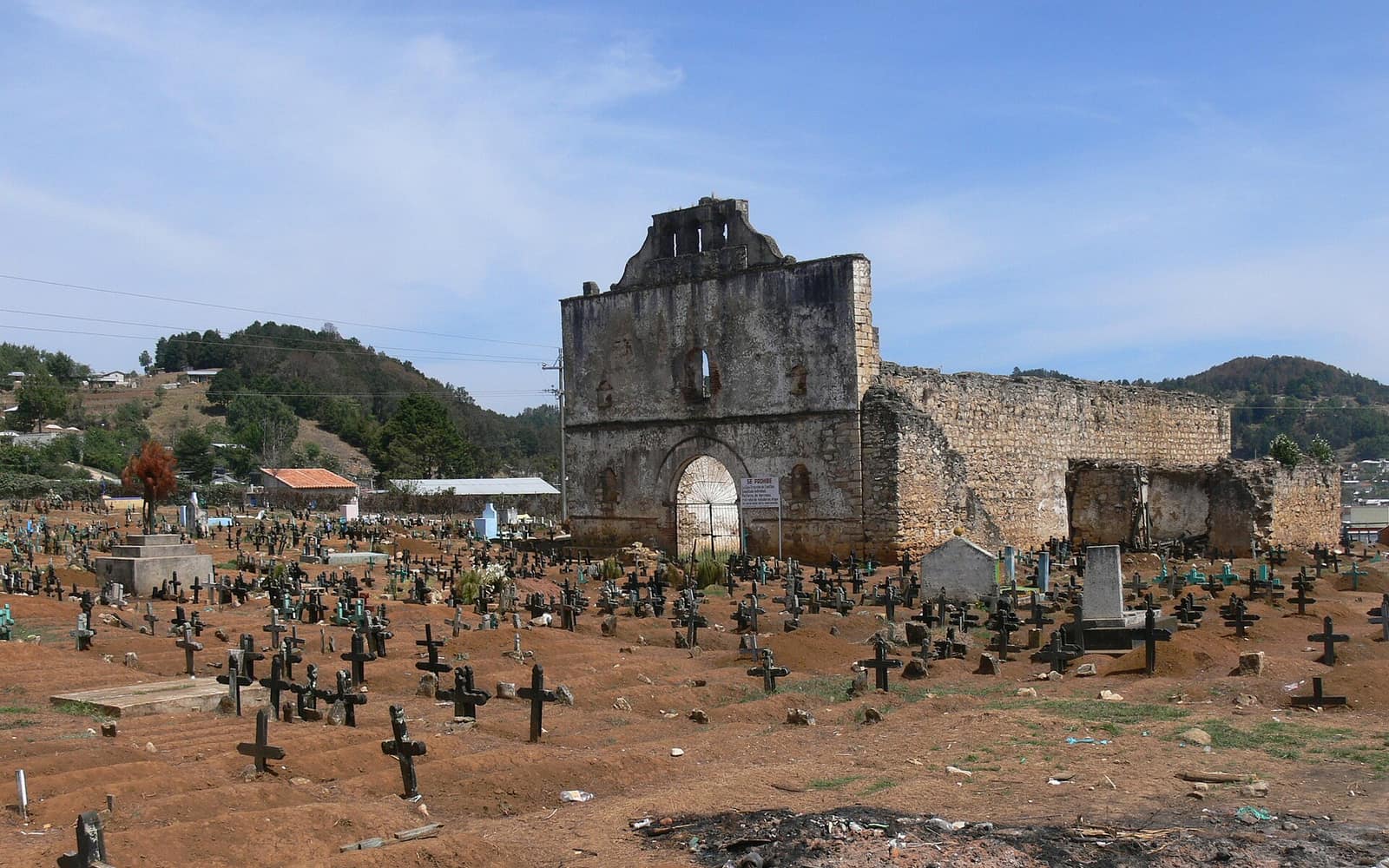
Sanctuaries · Chiapas · Tzotzil Maya · 16th-century church, living Maya tradition to the present
San Juan Chamula
A Tzotzil Maya town whose whitewashed church shelters a living religion practised on a floor of pine needles, by candlelight and copal smoke.
Living Tzotzil Maya place of worship, self-governing indigenous municipality
The doors open onto candlelight and the smell of pine and copal. There are no pews, only a floor of green needles where families kneel among rows of saints. Inside the church of San Juan Bautista, a Maya religion is not remembered but practised.
The living church
The church of San Juan Bautista looks, from the plaza, like a colonial parish: a whitewashed front, blue and green floral patterns around the doorway, a bell tower. Step inside and the expectation falls away. There is no altar service in the usual sense and no resident priest. The nave is open floor, carpeted end to end in pine needles, lit by rows of candles pressed straight onto the tiles. Along the walls stand the wooden saints, dressed and tended, each understood as a living presence rather than a statue.
The religion practised here is often called syncretic: Catholic form laid over a Maya core, with neither one fully in charge. Saints carry the names of the church calendar but are approached in the manner of older deities, and the work of the church is healing and petition rather than Mass. It grew this way over five centuries, and it is guarded closely by the town as its own.
Inside, in silence
A visit means standing quietly at the edge of other people's prayers. Families clear a patch of pine needles and set out candles in careful colours and rows. A healer may pass a live chicken or an egg over a sick person to draw out illness, murmur prayers, and offer sips of posh. Bottles of Coca-Cola and Pepsi appear too, because a belch is believed to release bad spirits from the body.
Because this is worship and not performance, restraint is everything. Photography inside the church is strictly forbidden, and photographing rituals or people without consent gives real offense. Enter softly, keep to the walls, do not point a camera or a phone, and let the room be what it is for the people using it.
A faith forged under Spain
The Tzotzil Maya farmed these highlands long before the Spanish arrived. Conquest reached the region in the 1520s, and the nearby Spanish town that became San Cristobal de las Casas was founded in 1528. Missionaries built the church at Chamula in the sixteenth century, by tradition on ground that was already sacred.
The town has a long memory of resistance. Between 1867 and 1870 it rose in a revolt remembered locally as Cuscat's War, sparked by taxation, land pressure, and a local cult of stones said to have fallen from the sky. What survives today is not a museum piece but a religion that absorbed the conquest and kept going on its own terms.
An autonomous town
Chamula runs itself. It has its own elected authorities and its own police, and outside police or soldiers do not enter without leave. Religious and civic office rotates through a ladder of stewardships, a demanding and expensive honour that binds the community together and funds its festivals.
That cohesion has a cost. From the early 1970s onward, traditionalist authorities began expelling residents who converted to evangelical Protestant churches, seen as a break with communal duty. Estimates run into the tens of thousands over the following decades, and many of the expelled, known as expulsados, built new neighbourhoods on the edges of San Cristobal. It is part of the honest picture of a place that holds hard to its own way.
Pine, copal, and candlelight
The materials carry the meaning. The pine needles underfoot are changed for fresh ones and understood as a link between the earth and the heavens. Copal, an aromatic tree resin burned since pre-Hispanic times, thickens the air. Candles are chosen and arranged by colour for what is being asked.
None of it is decoration. Each element is doing work in a ceremony, which is why the room asks for quiet rather than curiosity.
Did you know
- The diocese assigns no resident priest, ordained clergy visit only occasionally and mainly to perform baptisms, and daily worship is led by local stewards.
- Bottles of Coca-Cola and Pepsi are used in ritual, because a good belch is believed to expel bad spirits from the body.
- The town keeps its own police force, and state or federal officers do not enter without an invitation.
- Photography inside the church is enforced so strictly that offenders have been fined, detained, or ordered out of town.
- Since the early 1970s, tens of thousands of residents who converted to evangelical churches have been expelled from the municipality.
- There are no pews inside, worshippers clear a space in the pine needles and kneel directly on the floor.
- Nearly the entire population speaks Tzotzil, a Maya language, as a first language.
Through time
- Pre-1500s Tzotzil Maya establish farming communities across the Chiapas highlands.
- 1528 Spanish forces subdue the highlands and found nearby Ciudad Real, today San Cristobal de las Casas.
- 16th c. The church of San Juan Bautista is built, by tradition on an older Maya place of worship.
- 1867 to 1870 Chamula rises in the revolt remembered locally as Cuscat's War, against taxation and ladino rule.
- 1970s Traditionalist authorities begin expelling thousands of evangelical converts from the municipality.
- 1994 The Zapatista uprising erupts across the surrounding highlands, drawing world attention to Chiapas.
Before you go
San Juan Chamula lies about 10 km northwest of San Cristobal de las Casas. Shared vans, or colectivos, run from the market in San Cristobal, and many visitors come with a local guide who can explain what they are seeing and how to behave.
Sunday is the main market and ceremonial day, the most alive but also the busiest. Festivals such as the feast of San Juan in late June and Carnival are intense and are best approached with extra restraint.
A couple of hours covers the church and the plaza. Allow half a day if you continue to nearby Zinacantan.
Photography inside the church is strictly forbidden, and photographing rituals, ceremonies, or people without clear consent causes real offense and can lead to fines or expulsion from the town. This is a place of active worship, not a sight to consume, so buy a ticket at the tourist office, enter quietly, keep to the edges, and do not film or record. When in doubt, follow the lead of a local guide and keep the camera away.
A living sacred site. Presence here asks for restraint, not a checklist.
Sources: Wikipedia: San Juan Chamula, Chiapas · Atlas Obscura: Iglesia de San Juan in Chamula · SIPAZ: Chiapas, Scene of a Religious Conflict? · HistoricalMX: San Juan Chamula · The Washington Post: Religious Violence Erupts in Mexican Indian Village (1992)
Nearby & related
The rainforest Maya city of Pakal, where fine stone temples meet the jungle canopy.
Ancient · Chiapas WirikutaThe most sacred land of the Wixárika people, endpoint of an ancient pilgrimage across the desert.
Sanctuaries · San Luis Potosí Basílica de GuadalupeThe most visited Catholic shrine in the Americas, on a hill that was sacred long before it.
Sanctuaries · Mexico City YaxchilánA Classic Maya city on a horseshoe bend of the Usumacinta River, reachable only by boat, whose carved lintels record its rulers and their rituals.
Ancient · Chiapas ChalmaA canyon shrine to a Black Christ that grew over an older cave cult, and Mexico's second most important pilgrimage site after Guadalupe.
Sanctuaries · State of MéxicoHold ceremony in Mexico?
Each vertical opens with a curation round: verified, or not listed. Tell us who you are, what you hold, and where we can check you.
For practitioners →