Sanctuaries · Yucatán · Maya (Yucatec), later Spanish colonial Catholic · Maya city from c. 750 BC; Franciscan convent 1549 to 1561
Izamal
A Maya holy city where a giant Franciscan convent sits on a flattened pyramid platform and Maya temples still rise between the streets.
Pueblo Mágico (2002); on Mexico's UNESCO World Heritage Tentative List (2008)
Izamal wears its history in layers. A Maya holy city named for the creator god Itzamná still shows its pyramids between the streets, and on the flattened base of one of them the Franciscans raised a vast golden convent that became the great Marian shrine of the Yucatán.
The story
Long before the Spanish arrived, Izamal was a Maya city of the northern Yucatán plain, probably its largest. It grew as a religious centre named for Itzamná, the creator god, and drew pilgrims to temples of the sun god Kinich Ahau. Its peak came in the Classic period, roughly 250 to 900 CE, when the great pyramids were raised.
When the Franciscans came in the mid 1500s, they did not build beside the Maya city. They built on top of it, tearing down a large pyramid and raising their convent on its leveled platform. Izamal has carried both histories at once ever since.
What you are looking at
Five huge pre-Hispanic structures still stand inside the modern town, and around 80 have been catalogued in all. The largest, Kinich Kak Moo, is a solar pyramid about 35 metres high whose base runs nearly 200 metres a side, among the biggest buildings by volume in Mexico.
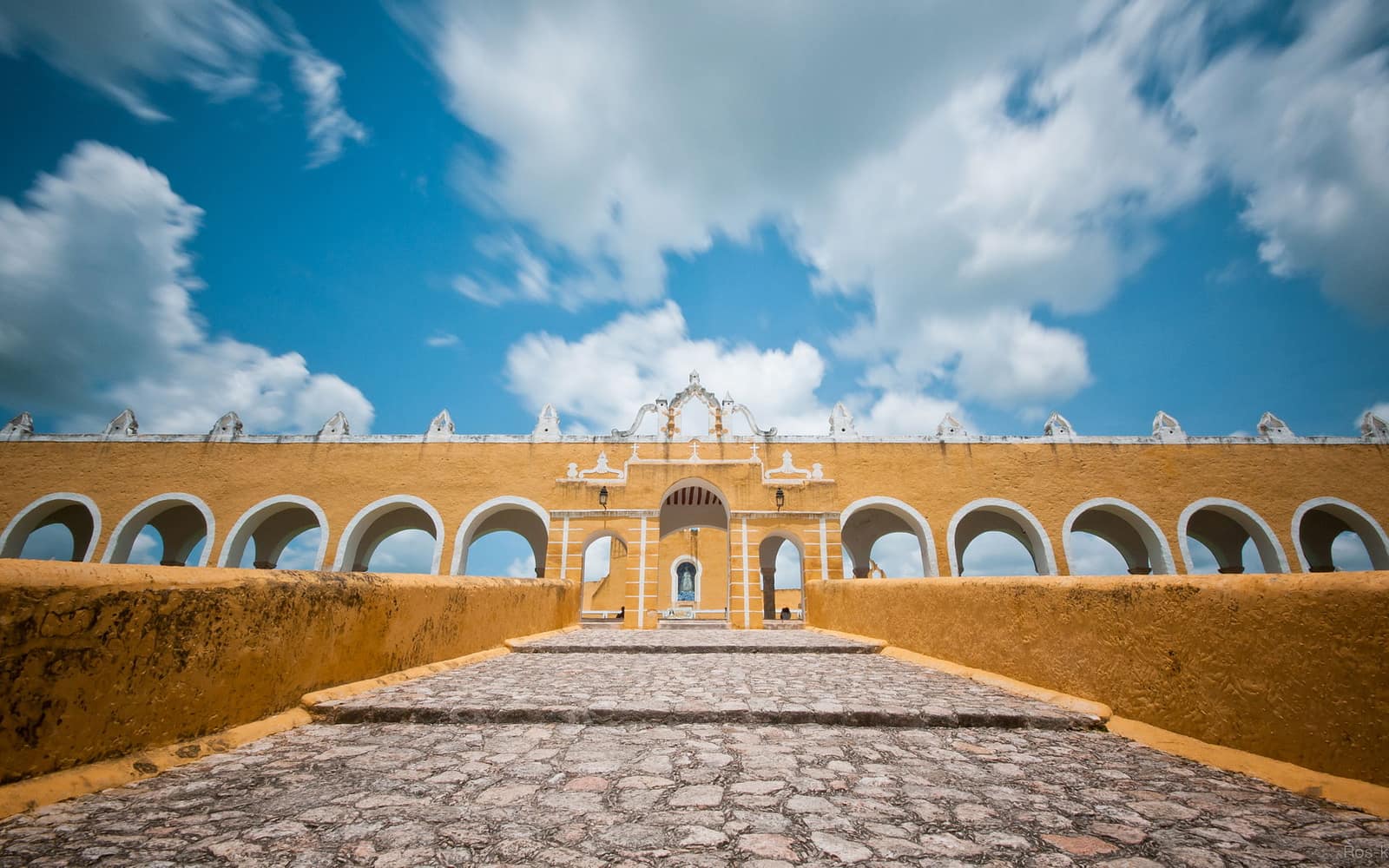
Above the main square rises the Convento de San Antonio de Padua, begun in 1549 and finished in 1561. Its walled atrium is one of the largest of any church in the world, and the whole complex sits on the flattened base of a Maya temple. Pyramids and cloister share the same few blocks.
Why it is sacred
To the Maya, Izamal was a place of the gods, tied to Itzamná and to the sun. Sacbeob, raised white stone roads, once ran from here to other cities, marking it as a hub of pilgrimage.
That role never really ended, it changed shape. Izamal is now the most important Marian shrine of the Yucatán Peninsula, home to Our Lady of Izamal, patroness of the state. According to devotion the image was crowned by Pope Pius XII in 1949, and Pope John Paul II came in 1993 to give it a silver crown and to meet with the indigenous peoples of the Americas.
Diego de Landa
The convent was founded by Fray Diego de Landa, later Bishop of Yucatán. He is remembered in two ways. In 1562 he ordered Maya books and sacred images burned, destroying much of a written culture.
Yet his own account of Maya life and writing, set down to justify the conquest, became one of the few keys later scholars had to the Maya script. Izamal holds that contradiction in stone: a Christian shrine built from a Maya one, by the man who tried to erase it.
Standing there today
Almost the entire old town is painted a deep golden yellow with white trim. By a common account the colours honour the Virgin and the Vatican and were tied to the 1993 papal visit, though the story varies.
Izamal has been a Pueblo Mágico since 2002 and sits on Mexico's UNESCO tentative list. People call it the City of Three Cultures, Maya, colonial, and living present, and all three are visible in a short walk.
Did you know
- The name Kinich Kak Moo means fiery macaw or sun-faced macaw, the solar deity the great pyramid honoured.
- The convent atrium is often called the second largest of any church in the world, after St. Peter's at the Vatican.
- Fray Diego de Landa burned Maya codices in 1562, yet his writings later helped scholars begin to read Maya glyphs.
- Landa had two twin statues of the Virgin made, one for Izamal and one for Mérida, brought from Guatemala around 1558.
- By local legend the Izamal statue grew impossibly heavy when people tried to carry it away to another town.
- Our Lady of Izamal has been crowned by two popes, Pius XII in 1949 and John Paul II in 1993.
- Izamal is nicknamed the City of Three Cultures for its Maya, colonial, and modern layers.
Through time
- c. 750 to 200 BC First Maya settlement on the site
- c. 250 to 900 CE Classic-period peak; Kinich Kak Moo raised
- 1549 Franciscans found the convent on a Maya platform
- 1561 Convento de San Antonio de Padua completed
- 1949 Virgin crowned by Pope Pius XII
- 1993 Pope John Paul II visits and crowns the image
- 2002 Izamal named a Pueblo Mágico
Before you go
Izamal lies about 72 km east of Mérida, roughly an hour by car or by bus. It also sits near the Mérida to Cancún route and Chichén Itzá, so it works as a day trip or a stop.
The dry, cooler months from November to March are most comfortable. Marian pilgrimages peak in May, in mid August, and around December 8.
Half a day covers the convent and Kinich Kak Moo; stay overnight to see the yellow streets quiet in the early morning light.
The convent is an active shrine, so dress modestly and keep quiet during Mass and among pilgrims. Climb only where the pyramids are open, and take nothing from the sites.
Sources: Izamal, Wikipedia · INAH, Archaeological Site of Izamal · UNESCO World Heritage Centre, Tentative List · Yucatán Today, Izamal
Nearby & related
The Maya city whose pyramid still catches the equinox serpent of light on its steps.
Ancient · Yucatán WirikutaThe most sacred land of the Wixárika people, endpoint of an ancient pilgrimage across the desert.
Sanctuaries · San Luis Potosí Basílica de GuadalupeThe most visited Catholic shrine in the Americas, on a hill that was sacred long before it.
Sanctuaries · Mexico City TulumA walled Maya port on a limestone cliff above the Caribbean, and one of the last Maya cities still lived in when Spanish ships first passed by.
Ancient · Quintana Roo UxmalA Late Classic Maya capital in the dry Puuc hills, its limestone palaces covered in masks of the rain god Chaac.
Ancient · YucatánHold ceremony in Mexico?
Each vertical opens with a curation round: verified, or not listed. Tell us who you are, what you hold, and where we can check you.
For practitioners →