Ancient · Veracruz · Classic Veracruz culture, later linked to the Totonac · c. 1st to 13th century CE, at its height around 800 to 1200 CE
El Tajín
A ruined Gulf Coast city whose Pyramid of the Niches carries one carved recess for every day of the solar year.
UNESCO World Heritage Site since 1992, protected as an INAH archaeological zone
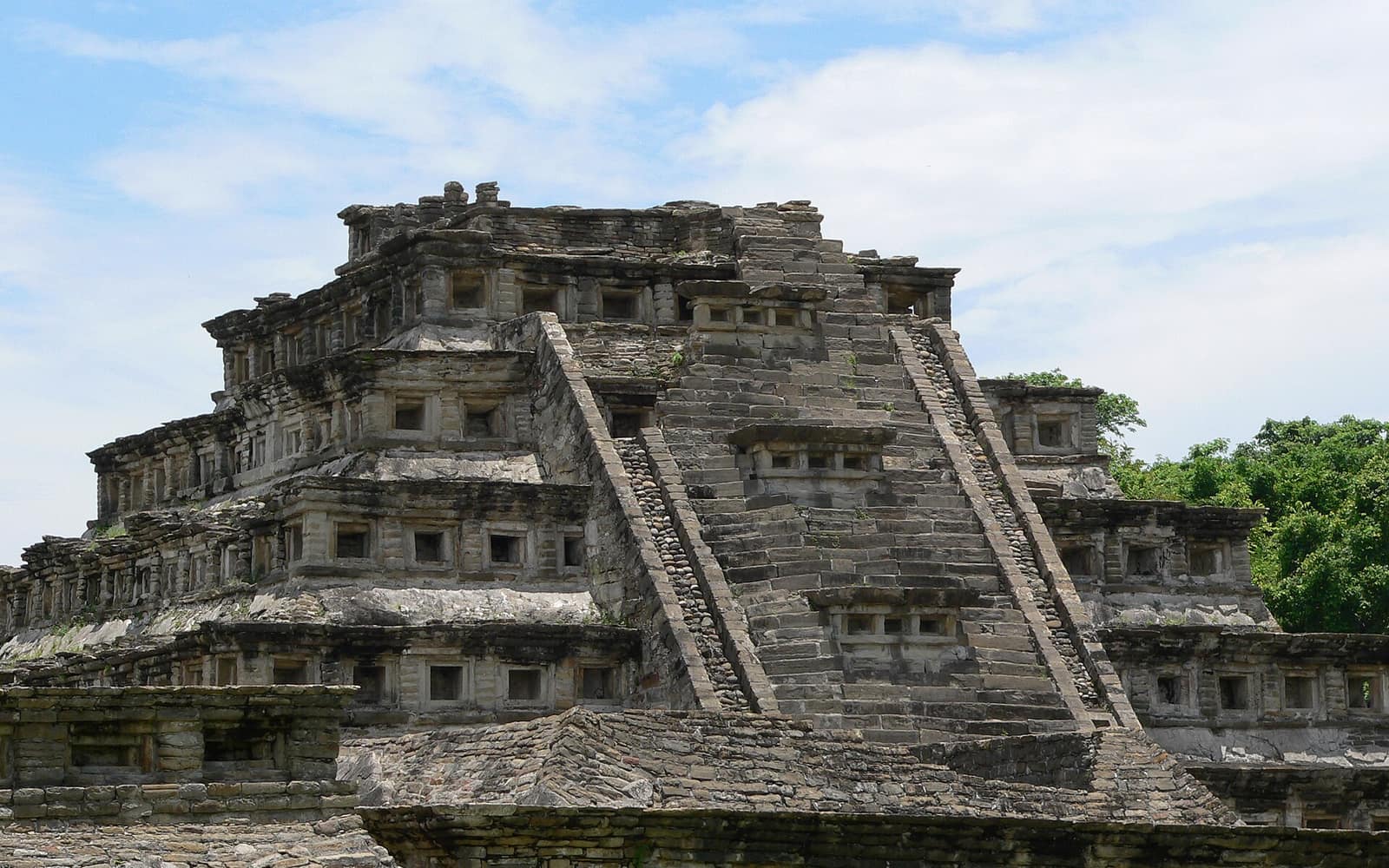
El Tajín is a ruined city in the forests of northern Veracruz, its grey stone pyramids rising out of green hills. Its signature monument, the Pyramid of the Niches, carries 365 carved recesses, one for every day of the solar year. It was the great capital of the Mesoamerican ballgame, and its living echo still spins overhead when the Voladores fly at the gate.
The story
El Tajín rose on the humid Gulf plain of what is now Veracruz. A small settlement stood here by the first century of the common era, but the city that survives took shape later, after the fall of Teotihuacan left a gap in central Mexico. Between roughly 800 and 1200 CE it became the leading centre of the northeastern lowlands, and its influence reached along the Gulf coast and inland toward the Maya region and the central highlands.
Who built it is still debated. The material belongs to what archaeologists call the Classic Veracruz culture, and the site was later claimed by the Totonac, whose descendants still live in the surrounding hills. There is also evidence of a Huastec presence when the settlement was young. The city burned in the early thirteenth century and was swallowed by forest until a government inspector, Diego Ruiz, reported the Pyramid of the Niches in 1785.
The Pyramid of the Niches
The building that gives El Tajín its fame is a stepped pyramid about twenty metres high. Every level is lined with deep square recesses, and the count comes to 365, one for each day of the solar year, with a further set along the staircase.
The niches are not decoration alone. They catch light and shadow that shift with the seasons, and the design reads as a calendar in stone. UNESCO calls the pyramid a masterpiece of ancient American architecture for exactly this marriage of geometry, astronomy and symbol.
A city built for the ballgame
El Tajín is the great capital of the Mesoamerican ballgame. At least seventeen ballcourts have been found inside the city, more than at any other known site, and later excavation has pushed the count higher.
Carved panels on the South Ballcourt show the game as a sacred and violent rite, including scenes read by scholars as the sacrifice of a player. The ballgame here was not sport in the modern sense. It was ritual, tied to fertility, rain and the movement of the sun.
Thunder and the calendar
The name Tajín is linked in Totonac tradition to thunder and lightning, and to the deity of storms and rain. That reading fits a place fixed on the sky. The niche pyramid, the layout of the plazas and the carved reliefs all point to a people who watched the calendar closely.
The site was more than a set of temples. It held palaces, ballcourts and elite residences, among them the hilltop complex of Tajín Chico, the seat of the ruling class in the city's last centuries.
The Voladores and a living culture
At the entrance to the ruins you will often meet the Voladores. Four performers climb a tall pole, tie ropes to their waists and drop backward into the air, spinning slowly toward the ground while a fifth plays a flute and drum at the top. By tradition each flyer circles thirteen times, and four flyers give fifty-two turns, matching the fifty-two year cycle of the Mesoamerican calendar.
The Danza de los Voladores is a living Totonac rite, recognised by UNESCO as Intangible Cultural Heritage in 2009. It is performed across the region, not only here, and the yearly Cumbre Tajín festival around the spring equinox brings Totonac performers, artisans and Voladores back to the site.
Did you know
- The pyramid carries 365 niches, one for each day of the solar year, with a dozen more set along the staircase.
- The name Tajín means thunder or lightning in Totonac, and is linked to the god of storms and rain.
- El Tajín holds at least seventeen ballcourts, more than any other known Mesoamerican city.
- The ruins lay hidden until 1785, when a government inspector hunting illegal tobacco crops stumbled on the Pyramid of the Niches.
- By tradition the four Voladores together make fifty-two turns in the air, matching the fifty-two year Mesoamerican calendar cycle.
- After Teotihuacan fell, El Tajín became the most important city in the northeastern corner of Mesoamerica.
- Every spring around the equinox the Cumbre Tajín festival fills the site with Totonac music, dance and Voladores.
Through time
- c. 1st century CE A settlement is founded on the Gulf plain.
- c. 600 to 900 CE The monumental core, including the Pyramid of the Niches, takes shape.
- c. 800 to 1200 CE El Tajín reaches its height as the leading city of the region.
- early 13th century The city is burned and abandoned, then lost to forest.
- 1785 Diego Ruiz reports the Pyramid of the Niches to the authorities.
- 1992 El Tajín is inscribed as a UNESCO World Heritage Site.
- 2009 The Voladores ritual is added to the UNESCO Intangible Cultural Heritage list.
Before you go
El Tajín sits near Papantla in northern Veracruz, about 12 kilometres from the town. Reach Papantla or nearby Poza Rica by bus, then take a local bus or taxi to the gate. The closest airport is at Poza Rica.
The dry months from November to April are most comfortable, and mornings are cooler and quieter. The Cumbre Tajín festival around the spring equinox is spectacular but very busy.
Allow two to three hours to walk the plazas, ballcourts and the Pyramid of the Niches, plus time for the museum and a Voladores performance.
Keep to the marked paths and do not climb the monuments. Watch the Voladores with respect and leave a donation, since it is both a sacred rite and their livelihood.
Sources: UNESCO World Heritage Centre: El Tajín, Pre-Hispanic City · INAH: El Tajín · Wikipedia: El Tajín · Encyclopaedia Britannica: El Tajín · UNESCO: Ritual ceremony of the Voladores
Nearby & related
The vast city of pyramids the Aztecs later called “the place where the gods were created.”
Ancient · State of México Chichén ItzáThe Maya city whose pyramid still catches the equinox serpent of light on its steps.
Ancient · Yucatán Monte AlbánA Zapotec capital levelled from a ridge-top, floating above the valley of Oaxaca.
Ancient · Oaxaca PalenqueThe rainforest Maya city of Pakal, where fine stone temples meet the jungle canopy.
Ancient · Chiapas TulumA walled Maya port on a limestone cliff above the Caribbean, and one of the last Maya cities still lived in when Spanish ships first passed by.
Ancient · Quintana RooHold ceremony in Mexico?
Each vertical opens with a curation round: verified, or not listed. Tell us who you are, what you hold, and where we can check you.
For practitioners →