Ancient · Tabasco · Olmec · c. 1200 to 400 BCE
La Venta
The Olmec capital of La Venta was one of the earliest planned cities in Mesoamerica, famous for its colossal basalt heads and one of the first great earthen pyramids.
Federally protected archaeological zone, managed by INAH
On a low island of high ground in the swamps of Tabasco, the Olmec built one of the first cities in Mesoamerica. More than three thousand years ago they carved colossal heads from basalt hauled across eighty kilometres, and heaped up an earthen pyramid taller than most of what stood in the Americas at the time. Much of what they left has since been moved to a park in Villahermosa, so the original ground now lies mostly quiet.
The story
The Olmec are the earliest of the great Mesoamerican civilisations, and La Venta was their capital during its final and grandest phase. It grew from around 1200 BCE, reached its height between roughly 900 and 400 BCE, and was then abandoned. No one knows why the site was left, and the Olmec left no readable writing to explain it.
Because so much that defines later Mexico appears first or early in Olmec work, from pyramids and the ballgame to a ritual calendar and jaguar and serpent imagery, they are often called the mother culture of the region. Some archaeologists prefer to see them as one influential culture among several. Either way, La Venta stands near the source of a tradition that ran for the next two and a half thousand years.
What you are looking at
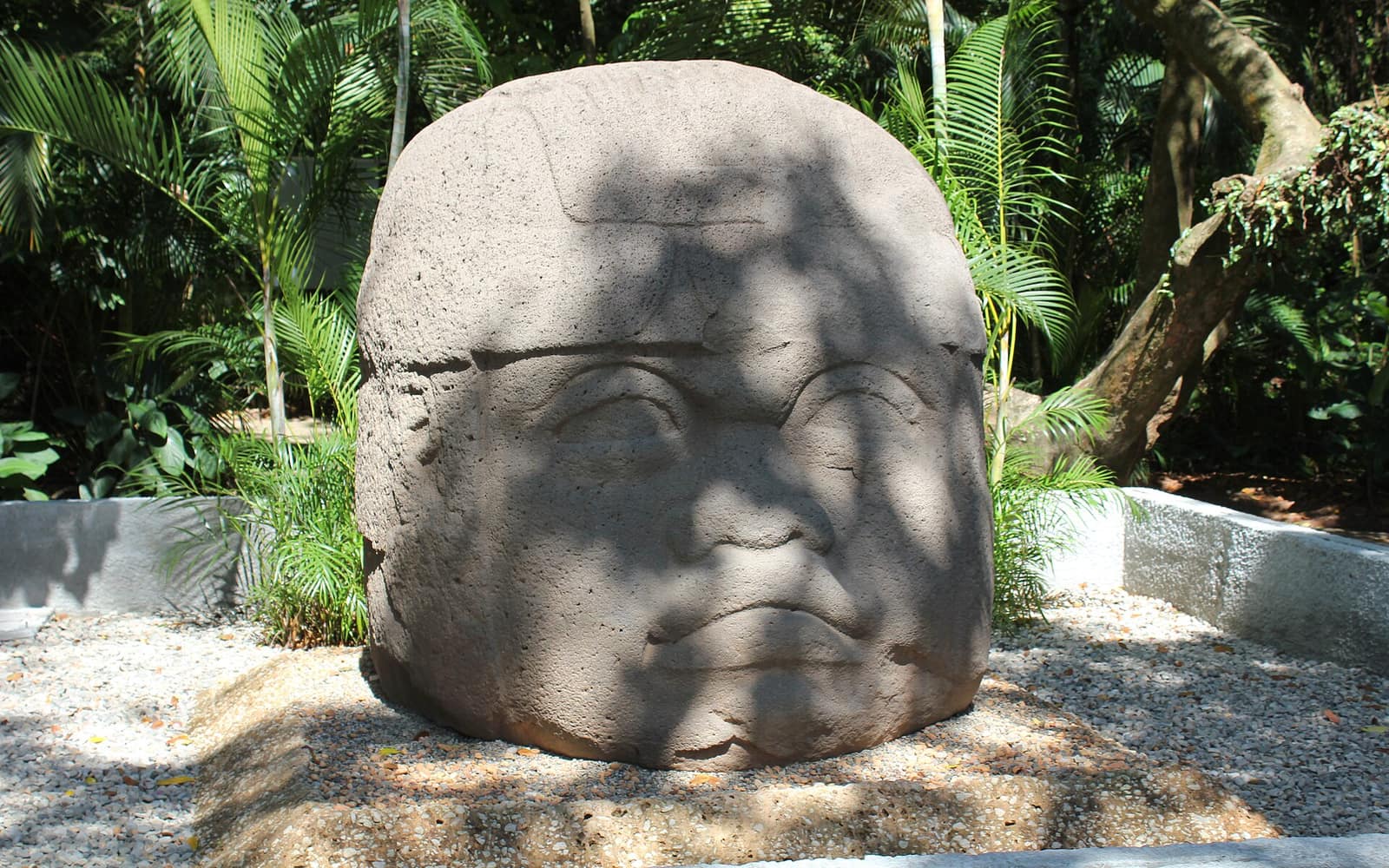
Four colossal heads were found at La Venta, each carved from a single block of volcanic basalt and standing up to nearly three metres tall. They are thought to be portraits of individual rulers, wearing close-fitting helmets, and the stone for them was quarried in the Tuxtla Mountains and moved more than eighty kilometres without wheels or draught animals.
Dominating the site is the Great Pyramid of Complex C, an earthen mound more than thirty metres high and among the oldest large pyramids in Mesoamerica. Long taken for a simple cone, it may originally have been rectangular with stepped or fluted sides, worn round by twenty-five centuries of rain.
The buried offerings
La Venta was above all a ceremonial place, and its most remarkable treasures were meant never to be seen again. Beneath the plazas, the Olmec buried caches of polished jade celts, mirrors of iron ore, and figurine groups arranged as if in council.
They also sank massive offerings of serpentine, a green stone hauled in from far away. In one deposit, some fifty tons of finished serpentine blocks were laid down and then sealed under thousands of tons of clay. Other offerings formed mosaic masks of the earth or jaguar, completed and immediately covered over. The labour was enormous, and the point seems to have been the giving, not the display.
The rescue to Villahermosa
In the 1950s, oil and gas were found around La Venta, and the state company PEMEX began to develop the area, damaging the ancient ground. To save the monuments, the Tabascan poet Carlos Pellicer led an effort to move many of them, some weighing over twenty tons, through swamp and forest to the state capital.
The result was the Parque-Museo La Venta, opened in Villahermosa in 1958, where more than thirty Olmec sculptures now stand outdoors among tropical vegetation and native animals. It remains the main place to meet the art of La Venta face to face.
Standing there today
The original site is a quiet, humid clearing on the Tabasco lowlands. The southern end was taken over by petroleum works, the great heads and altars have gone to Villahermosa, and replicas now mark where they once stood. What survives on the spot is mainly the shape of the land: the mounds, the plazas, and the eroded bulk of the Great Pyramid.
It asks for imagination. There is little to read on the stones and few crowds, but standing at the foot of the pyramid you are on ground that people planned and shaped more than three thousand years ago, at the very start of urban life in this part of the world.
Did you know
- The basalt for the colossal heads was dragged more than eighty kilometres from the Tuxtla Mountains, without the wheel or any draught animals.
- One buried offering held about fifty tons of serpentine blocks, sealed under thousands of tons of clay and never meant to be seen again.
- Some of the finest serpentine work was laid as mosaic masks of the earth or jaguar, then covered over as soon as it was finished.
- La Venta had almost no local stone, so every monument was carved from rock imported across long distances.
- The man who saved the monuments, Carlos Pellicer, was a poet rather than an archaeologist, and he designed the Villahermosa park himself.
- The Great Pyramid's rounded, cone-like form may be the eroded remains of an originally stepped and fluted rectangular building.
Through time
- c. 1200 BCE La Venta rises as an Olmec ceremonial centre on high ground in the Tabasco wetlands
- c. 900 to 400 BCE The city reaches its height: colossal heads carved and the Great Pyramid raised
- c. 400 BCE La Venta is abandoned for reasons still unknown
- 1925 Frans Blom and Oliver La Farge document the ruins for a wider audience
- 1940 to 1943 Matthew Stirling and Philip Drucker excavate Complex A and its offerings
- 1957 to 1958 Carlos Pellicer moves monuments to Villahermosa; the Parque-Museo La Venta opens
- 1980s INAH begins a long-term project to protect and study the original site
Before you go
The archaeological zone sits by Villa La Venta in Huimanguillo, about 128 km west of Villahermosa off Highway 180 toward Coatzacoalcos. Many visitors instead go straight to the Parque-Museo La Venta in Villahermosa itself, where the rescued monuments now stand.
Early morning in the dry season, roughly November to April, before the Gulf heat and humidity build.
An hour or so at the largely bare original zone. Allow two to three hours for the Villahermosa museum-park.
The monuments are ancient and fragile. Do not climb on or touch the sculptures, and keep to the marked paths.
Sources: INAH, La Venta archaeological zone · Wikipedia, La Venta · Britannica, La Venta · The Met, La Venta essay · Sistema de Informacion Cultural, Parque Museo La Venta
Nearby & related
The vast city of pyramids the Aztecs later called “the place where the gods were created.”
Ancient · State of México Chichén ItzáThe Maya city whose pyramid still catches the equinox serpent of light on its steps.
Ancient · Yucatán Monte AlbánA Zapotec capital levelled from a ridge-top, floating above the valley of Oaxaca.
Ancient · Oaxaca PalenqueThe rainforest Maya city of Pakal, where fine stone temples meet the jungle canopy.
Ancient · Chiapas TulumA walled Maya port on a limestone cliff above the Caribbean, and one of the last Maya cities still lived in when Spanish ships first passed by.
Ancient · Quintana RooHold ceremony in Mexico?
Each vertical opens with a curation round: verified, or not listed. Tell us who you are, what you hold, and where we can check you.
For practitioners →