Ancient · Oaxaca · Zapotec (later Mixtec) · c. 500 BCE – 850 CE
Monte Albán
A Zapotec capital levelled from a ridge-top, floating above the valley of Oaxaca.
UNESCO World Heritage · INAH zone
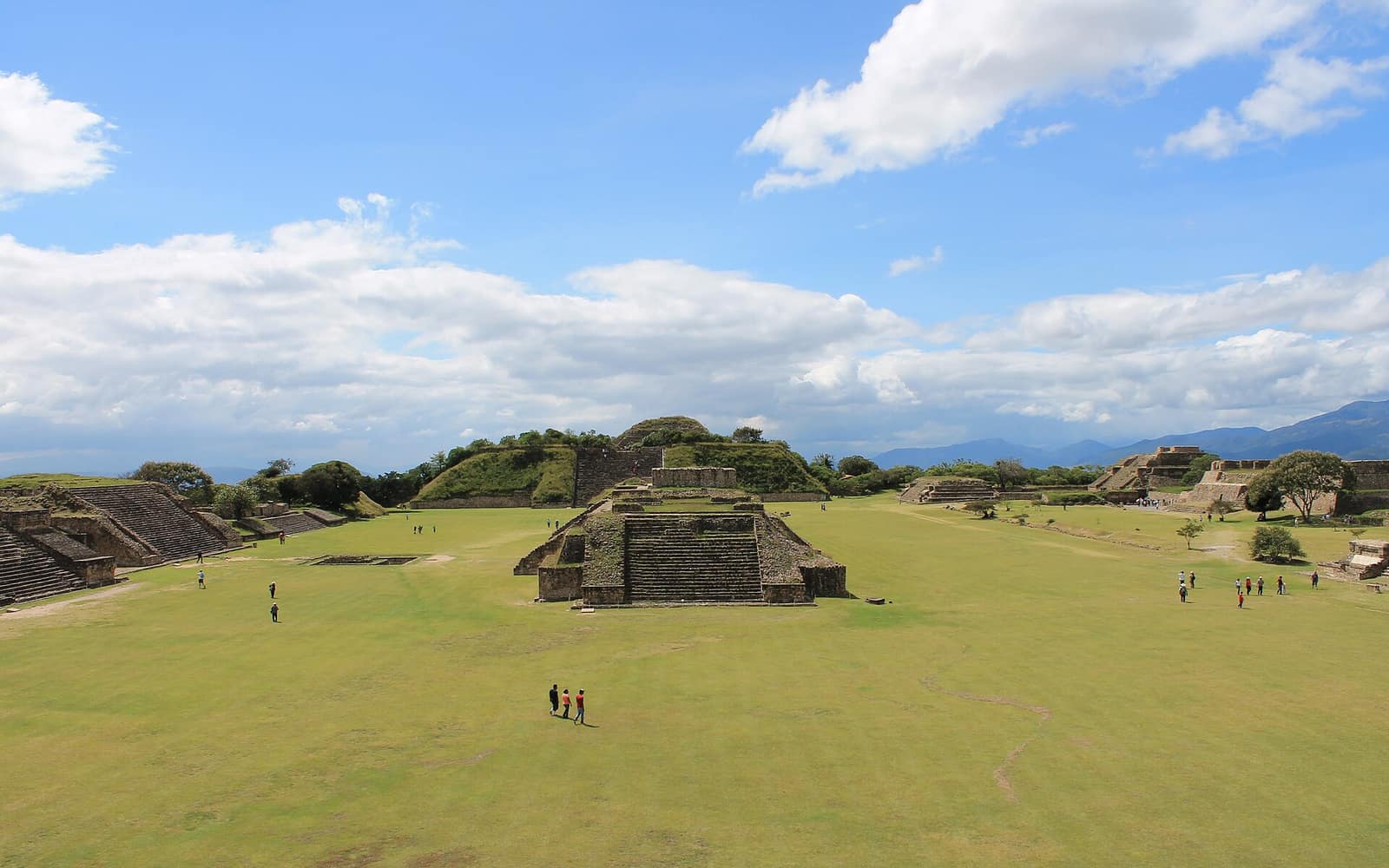
Monte Albán is a mountaintop that people flattened. Around 500 BCE the Zapotecs cut the peaks off a ridge above the valley of Oaxaca and packed the hollows with rubble, building a level plaza in the sky by hand, without wheels, pack animals, or metal tools. What they left is not a ruin so much as an idea about how high a city can sit and still hold the whole world in view.
The story
The Zapotecs founded Monte Albán toward the end of the Middle Formative period, around 500 BCE, on a ridge that rises about 400 meters above the floor of the Oaxaca valley where three arms of the valley meet. It grew fast. Within a few centuries it was one of the earliest true cities in the Americas, the seat of a state that pulled tribute and labor from the surrounding countryside.
At its height, during the Classic period roughly between 500 and 700 CE, tens of thousands of people lived on the hill and its terraces, with estimates commonly placed around 25,000. Then, for reasons still argued over, its political grip loosened. By the end of the Late Classic the city had lost its preeminence, and soon after the ridge was largely emptied.
The Zapotecs did not vanish, and neither did the place. Centuries later, in the Postclassic, Mixtec lords returned, not to rebuild the city but to bury their dead among its old stones. That single fact tells you how the hill was remembered long after its markets and courts went quiet.
What you are looking at
The heart of the site is the Main Plaza, a leveled esplanade roughly 300 meters long, ringed by platforms, temples, and staircases. To make it, workers dug thousands of tons of rock from the higher points and filled the low ground, a project that ran across generations. A few outcrops proved too stubborn to move, so several buildings sit on the living rock they could not clear.
Two features tend to stop people. Building J, near the plaza's south end, is shaped like an arrowhead and set at an odd angle to everything around it, aligned to the sky rather than to the grid. Its slabs name towns the city claimed to have conquered, some marked with an inverted head for a defeated ruler. And there is a stone ballcourt, a sunken I-shaped alley where a ritual game was played long before the rules were written down anywhere we can read.
Beyond the ceremonial core the whole mountain was carved into hundreds of terraces for houses and crops, along with tombs, some of them painted, that carry the site's religious life down into the ground.
The stones that speak
Set into a platform on the plaza's west side are the Danzantes, the Dancers, more than 300 carved slabs of contorted human figures. The name is a misnomer that stuck. Most scholars now read them not as dancers but as slain or sacrificed war captives, their bodies limp, some marked with signs of mutilation.
They matter beyond the shock of the imagery. Alongside them appear some of the earliest writing and calendrical notation in Mesoamerica, glyphs and numbers that mark Monte Albán as one of the places where the region's script first took shape. Here, power and record keeping were carved into the same stones.
Why it is sacred
UNESCO describes the terraces, dams, canals, pyramids, and mounds of Monte Albán as a sacred topography, a landscape shaped into an act of belief rather than only an act of engineering. To level a mountain and haul every stone and basket of soil up its slopes, for generation after generation, is a religious commitment as much as a practical one.
The Zapotecs looked to Cocijo, the deity of lightning and rain, and the temples and tombs speak to a world where royal ancestors interceded for the living and where offerings, including blood, were given to keep the rains coming. The famous Tomb 7, opened by the archaeologist Alfonso Caso in 1932, held more than 500 objects of gold, silver, turquoise, jade, and carved bone. It was a Zapotec tomb that the Mixtec reopened and reused, proof that the hill stayed holy ground long after it stopped being a capital.
The Zapotec and Mixtec peoples are not gone. They live across Oaxaca today, and the site is part of a living heritage, not a closed chapter.
Standing there today
The reward is partly the walk and partly the air. From the plaza the land drops away on every side, and the valley of Oaxaca spreads out below, which is exactly the point the Zapotecs were making when they chose this ridge. You feel the altitude and the exposure. There is little shade and a lot of sky.
Move slowly. Climb the platforms that are open, read Building J's crooked geometry against the tidy grid of everything else, and give the Danzantes a close look before the tour groups arrive. The small on-site museum sets the carvings in context. Early morning, when the light is low and the crowds are thin, is when the place feels most like what it was.
Did you know
- The Zapotecs flattened a mountaintop by hand, hauling away thousands of tons of rock without wheels, draft animals, or metal tools.
- The ancient name of the city is lost; Monte Albán is a Spanish name whose origin is still debated.
- Building J sits crooked against the plaza's tidy grid because it is aligned to the sky, not to the buildings around it.
- The carvings called the Dancers are now read by most scholars as slain or sacrificed war captives, not dancers.
- Building J's slabs read like a war record, naming conquered towns, some with an upside-down head for a defeated ruler.
- Tomb 7 held more than 500 objects, including gold and turquoise, buried by Mixtec lords who arrived centuries after the Zapotecs left.
- Some of Mesoamerica's earliest writing and calendar signs appear on the stones here, among the region's first records in script.
Through time
- c. 500 BCE Zapotecs level the ridge and found the city
- c. 300 BCE Danzantes carved, with some of the earliest local writing
- c. 100 BCE Building J raised, its slabs listing conquered towns
- c. 600 CE Classic peak, around 25,000 people on the mountain
- c. 800 CE Political power fades and the hilltop is largely emptied
- 1932 CE Alfonso Caso opens Tomb 7 and its Mixtec treasure
- 1987 CE UNESCO World Heritage listing, with Oaxaca's old city
Before you go
The site sits about 10 km southwest of Oaxaca city, roughly a 20 to 30 minute drive. Tourist shuttles run through the day from downtown, and taxis and guided tours are easy to arrange.
Come at opening, around 8 in the morning, for cool light and thin crowds. The dry months from November to April are the most reliable for clear valley views.
Allow two to three hours to walk the Main Plaza, the Danzantes, Building J, and the small site museum without rushing.
Stay off roped structures and never touch the carved stones. Bring water, a hat, and sun protection, since the ridge is high and exposed. Treat it as living Zapotec and Mixtec heritage, not just an ancient ruin.
Sources: UNESCO World Heritage Centre, Historic Centre of Oaxaca and Monte Albán · INAH, Zona Arqueológica de Monte Albán · Wikipedia, Monte Albán · National Geographic, Who wore the golden pectoral of Monte Albán · INAH, Tomb 7 of Monte Albán
Nearby & related
The vast city of pyramids the Aztecs later called “the place where the gods were created.”
Ancient · State of México Chichén ItzáThe Maya city whose pyramid still catches the equinox serpent of light on its steps.
Ancient · Yucatán PalenqueThe rainforest Maya city of Pakal, where fine stone temples meet the jungle canopy.
Ancient · Chiapas Hierve el AguaPetrified “waterfalls” of mineral springs, a Zapotec bathing and ritual site for millennia.
Nature · Oaxaca TulumA walled Maya port on a limestone cliff above the Caribbean, and one of the last Maya cities still lived in when Spanish ships first passed by.
Ancient · Quintana RooHold ceremony in Mexico?
Each vertical opens with a curation round: verified, or not listed. Tell us who you are, what you hold, and where we can check you.
For practitioners →