Ancient · Chiapas · Classic Maya · Classic Maya, c. 359 to 810 CE
Yaxchilán
A Classic Maya city on a horseshoe bend of the Usumacinta River, reachable only by boat, whose carved lintels record its rulers and their rituals.
Federal archaeological zone protected and managed by INAH
Yaxchilán hides on a horseshoe bend of the Usumacinta River, at the jungle border between Mexico and Guatemala, reachable only by boat. Its temple doorways are spanned by carved stone lintels that record, in unusual detail, the kings of a Maya dynasty and the bloodletting rites that anchored their power. Howler monkeys still roar through the ruins.
The story
Yaxchilán began as a minor river settlement. Its recorded history opens around 359 CE with the enthronement of Yopaat Bahlam I, founder of a dynasty that would rule for roughly four and a half centuries.
The city reached its height under Itzamnaaj Bahlam II, known as Shield Jaguar, who reigned from 681 to 742 CE, and his son Bird Jaguar IV, who ruled from 752 to 768 CE. Both left ambitious building programs, and their great rival downstream was the city of Piedras Negras. The last dated monuments fall around 810 CE, after which Yaxchilán was abandoned and the forest closed over it.
The carved lintels
Yaxchilán is famous above all for its stone. More than 120 inscriptions survive across lintels, stelae, altars, and hieroglyphic stairways, one of the richest written records left by any Maya city.
The lintels are stone beams set above temple doorways, their undersides carved in low relief. Structure 23, built for Shield Jaguar, holds the best known set. Lintel 24 shows his consort Lady K'abal Xook drawing a thorn-lined rope through her tongue, with traces of red and blue paint still clinging to the limestone. Rare for Maya art, one lintel even carries the signature of its sculptor.
Blood and kingship
The scenes on the lintels are not decoration. They record bloodletting rites performed by rulers and their wives, in which they drew their own blood as an offering.
According to Maya belief, this royal blood opened a passage to the world of gods and ancestors, and it bound the king's authority to the sacred order. The Yaxchilán lintels are among the clearest surviving images of how the Classic Maya understood the link between rulership and ritual.
Reaching it by river
There is no road to Yaxchilán. Visitors drive to Frontera Corozal on the Usumacinta, then take a lancha, a long motor canoe, roughly forty minutes to an hour along the river to the site.
The boats are run by a local Maya cooperative. The river here marks the border between Chiapas and Guatemala, and the surrounding Lacandon jungle keeps the ruins isolated, which is much of why they feel the way they do.
A living connection
Yaxchilán is an archaeological zone protected by Mexico's INAH, but it is not only a ruin. Some Lacandon Maya still make pilgrimages here to leave offerings and carry out rituals to the old gods.
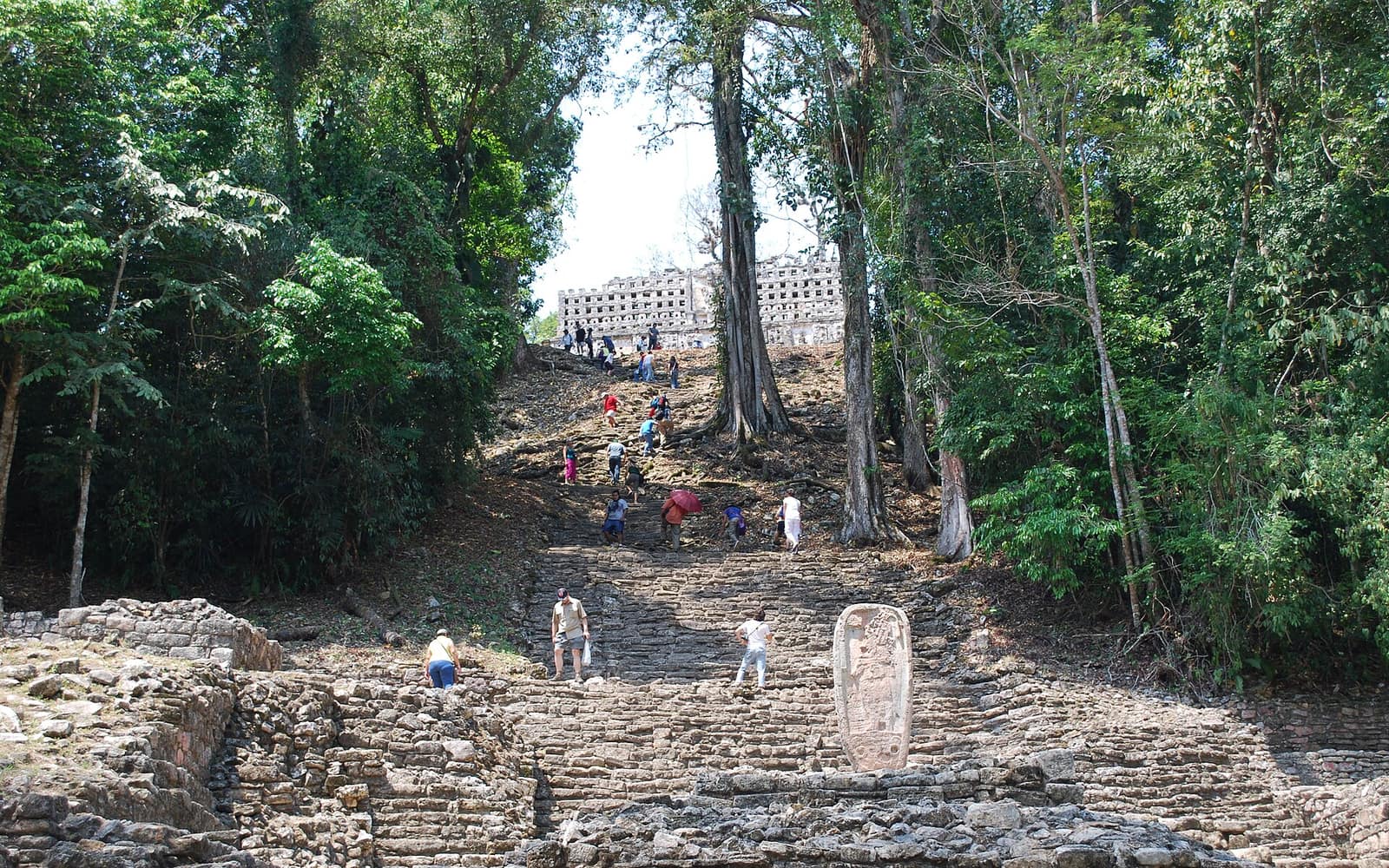
Standing in the Great Plaza today, with Structure 33 rising on its terrace above the river and howler monkeys calling from the canopy, the distance between the ancient city and the living one feels short.
Did you know
- The city's ancient Maya name was Pa' Chan, usually read as Cleft Sky.
- Lintel 24 shows Lady K'abal Xook pulling a thorn-studded rope through her tongue, and still holds flecks of its original red and blue paint.
- One of the lintels is signed by its carver, a sculptor named Mo' Chaak, which is very unusual in Maya monumental art.
- Structure 19 is nicknamed the Labyrinth for its dark, interconnected interior passages.
- Structure 33, the temple of Bird Jaguar IV, rises about 40 metres above the Great Plaza and keeps much of its tall roof comb.
- The ruins came to wider attention in 1882, when Alfred Maudslay and Désiré Charnay reached them within days of each other.
Through time
- c. 359 CE Yopaat Bahlam I is enthroned; the dynasty begins
- 681 to 742 CE Reign of Itzamnaaj Bahlam II, Shield Jaguar
- c. 726 CE Structure 23 lintels carved, showing Lady K'abal Xook's bloodletting
- 752 to 768 CE Reign of Bird Jaguar IV; Structure 33 built
- c. 810 CE Last dated monuments; the city is abandoned
- 1882 CE Maudslay and Charnay document the ruins for the wider world
Before you go
From Palenque, travel by road to Frontera Corozal on the Usumacinta River, then take a shared or private lancha, a motor canoe run by a local Maya cooperative, about forty minutes to an hour to the site. There is no land route in.
The dry season, roughly November to April, brings easier roads and calmer river travel. Start early to reach the ruins before the midday heat and the day-tour crowds.
Allow two to three hours at the site itself, and a full day from Palenque once the drive and boat are counted.
Stay on marked paths, do not touch or climb on the carved lintels and stelae, and treat the place as still sacred to the Lacandon Maya. Take out everything you bring in.
Sources: INAH: Zona Arqueológica de Yaxchilán · Wikipedia: Yaxchilan · World History Encyclopedia: Yaxchilan · Smarthistory: The Yaxchilán Lintels · Wikipedia: Yaxchilan Lintel 24
Nearby & related
The vast city of pyramids the Aztecs later called “the place where the gods were created.”
Ancient · State of México Chichén ItzáThe Maya city whose pyramid still catches the equinox serpent of light on its steps.
Ancient · Yucatán Monte AlbánA Zapotec capital levelled from a ridge-top, floating above the valley of Oaxaca.
Ancient · Oaxaca PalenqueThe rainforest Maya city of Pakal, where fine stone temples meet the jungle canopy.
Ancient · Chiapas TulumA walled Maya port on a limestone cliff above the Caribbean, and one of the last Maya cities still lived in when Spanish ships first passed by.
Ancient · Quintana RooHold ceremony in Mexico?
Each vertical opens with a curation round: verified, or not listed. Tell us who you are, what you hold, and where we can check you.
For practitioners →